Who invented avalanche beacons?

The arrival of the modern avalanche transceiver fundamentally changed how quickly buried victims could be found in the snowpack, transitioning rescue from a grueling physical effort to a precise electronic search. While many companies and brilliant minds have contributed to the sophisticated gear we carry today, the initial breakthrough belongs squarely to one man and his creation in the late 1960s. [2][4] The need for such a device was starkly apparent to anyone spending time in the backcountry, driven by the terrifying reality that minutes—even seconds—determined survival when someone vanished under tons of snow. [2]
# Lawton's Drive

Before electronic aids, rescue relied entirely on visual sighting, rapid shoveling, and the painstaking use of long metal probes, often in low visibility and high stress. [2] John Lawton, an engineer, was profoundly motivated by a personal, close encounter with the consequences of slow rescue times. [4] This experience provided the necessary impetus to channel his technical skills toward solving the life-or-death problem of locating a buried skier. [4] Lawton dedicated his work to creating a device that could emit a signal to guide rescuers, overcoming the difficulty of searching under deep, opaque snow. [4]
# Skadi Breakthrough
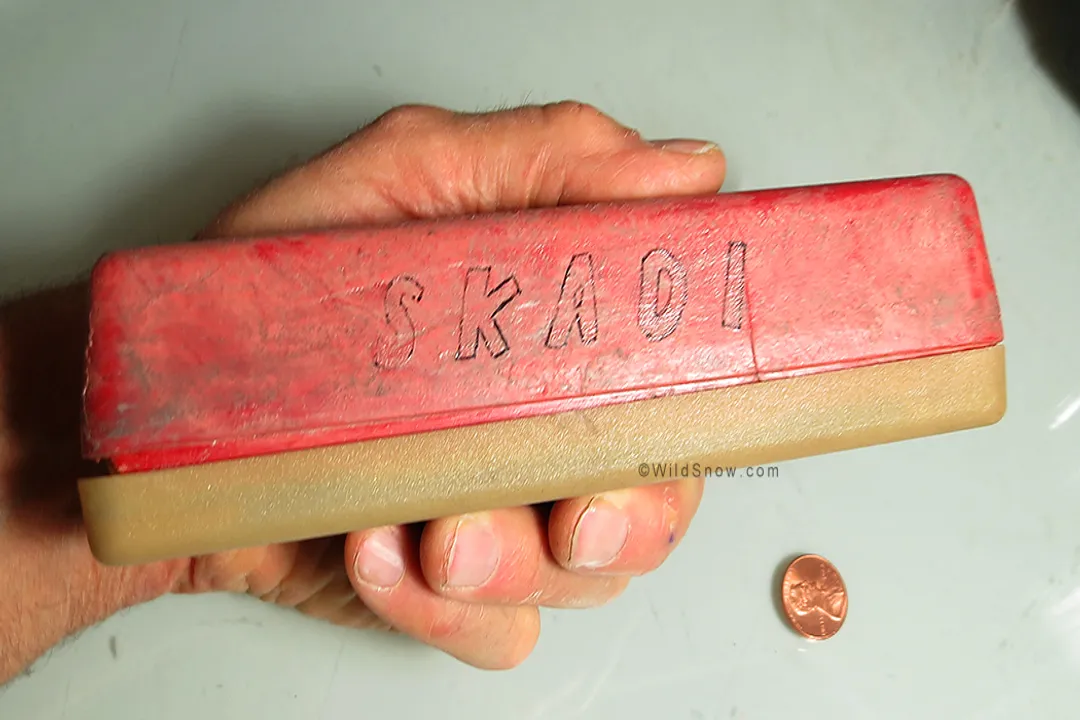
The culmination of Lawton's efforts arrived in 1968 with the introduction of the Skadi beacon. [3][4] This device is widely recognized as the first commercially successful avalanche transceiver. [4] Lawton developed the Skadi while working for the Safety Equipment Company. [4] It operated on a simple, yet revolutionary, send-and-receive mechanism, relying on a single antenna to broadcast a signal that a nearby receiver could pick up. [2][5] The concept was straightforward: if you were buried, your beacon sent a pulse; if you were searching, your beacon received that pulse. [1]
The Skadi marked a monumental shift in backcountry safety, moving the search process from guesswork and topography estimation to a measurable, repeatable electronic process. [2] While Lawton's invention provided the foundational principle—the electronic heartbeat under the snow—the early analog versions required users to interpret signal strength changes, often involving large, sweeping directional movements with the search antenna. [5]
# Analog Era
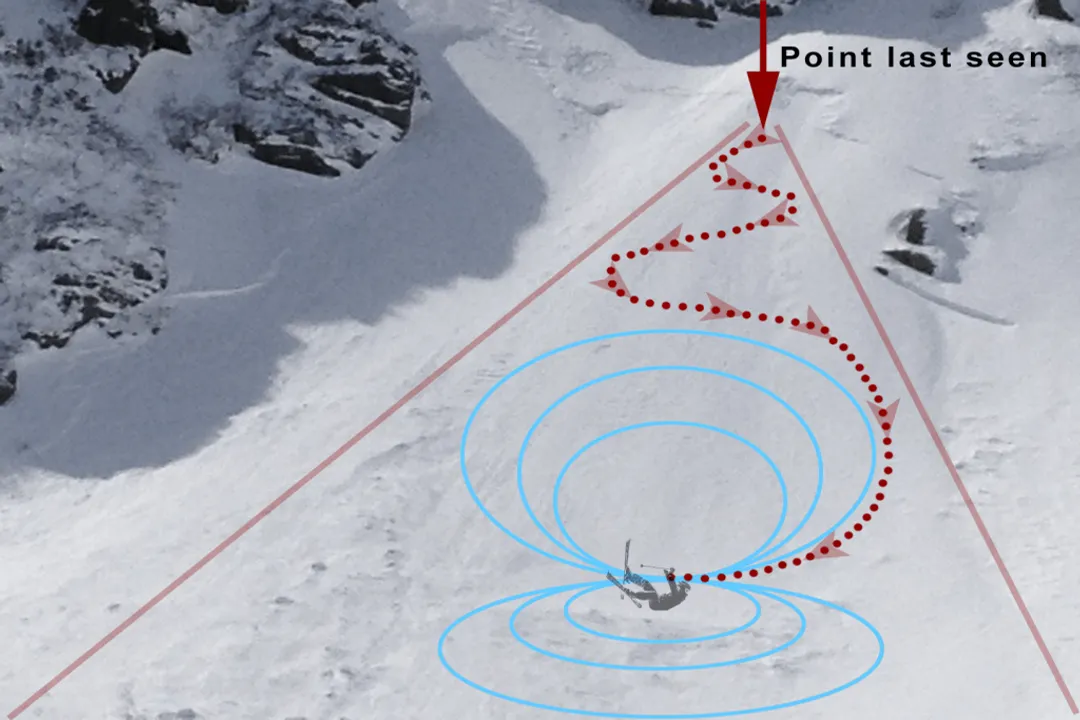
The early transceivers, like the Skadi, were strictly analog devices. [5] They transmitted on a specific frequency, usually around 457 kHz. [1] A rescuer would switch their unit to "receive" mode and listen for the tone, turning their body or antenna until the signal was strongest, indicating they were pointed directly at the victim's beacon. [2][5] The search process involved tracking the signal strength down until it was loudest, then switching to a precise search pattern, often marked by a probe strike when the signal abruptly disappeared, indicating proximity. [2]
It is easy, looking back at the sleek, screen-guided devices of today, to undervalue the impact of these initial analog units. However, consider the sheer time compression offered by even Lawton’s basic technology. Before 1968, finding a beacon-equipped person meant relying on a visual marker, a dropped pole, or the slim chance of a probe finding the victim by luck within the critical first 15 minutes. [4] The Skadi, despite its technical simplicity, replaced hours of exhausting, often fruitless probing with a systematic, directional electronic search that dramatically improved the odds. [5] This initial success spurred other manufacturers to enter the market and refine the technology. [2]
# Digital Leap
The next major evolutionary step occurred in the 1970s and 1980s with the introduction of digital technology. [5] This transition was not merely an upgrade; it redefined the search experience. [1] Digital beacons incorporated microprocessors that could analyze the incoming signal far more intelligently than an analog receiver could interpret fluctuating audio tones. [5]
The key advancement here was the integration of multiple antennas—often three, though modern units can boast more. [1][5] A three-antenna system allows the beacon to determine not just the strength of the signal, but its direction in three dimensions. [1] Instead of the user having to physically sweep their antenna in an arc to find the strongest point, the digital display directs the searcher with an arrow or distance reading, significantly reducing the time spent on the initial approach. [5] This move from interpretation to direct instruction made the search process faster, more intuitive, and significantly reduced user error under pressure. [1]
This technological refinement created a standard that remained dominant for decades, though the complexity of modern multi-signal environments (where multiple victims or sources of interference exist) continues to challenge even the best processors. [5]

# Modern Systems
Contemporary avalanche transceivers are marvels of miniaturization and processing power, but they still adhere to the fundamental transmission frequency established long ago. [1] The focus today is on refining the search experience to handle complex scenarios, such as multiple burials or deeply buried victims. [1][5] Advanced features often include signal suppression modes, which allow a rescuer wearing a beacon to temporarily ignore signals from other rescuers' beacons while focusing only on the target signal, and marking features that help isolate one victim's signal from others during a group search. [1]
Furthermore, battery technology and power management have become critical aspects of modern beacon design, as prolonged searches drain power, and low battery life poses a direct threat to the device's ability to transmit if the searcher becomes the victim. [1] The continuous improvement in processing speed and range means that newer models can often distinguish between signals at a greater depth or distance than their predecessors, though the practical search range remains heavily dependent on snow conditions and battery charge. [5]
It's easy to fall into the trap of thinking that the newest, most expensive beacon automatically equates to the safest backcountry experience. While digital advancements offer undeniable benefits in speed and accuracy, the most significant factor in any electronic rescue remains the human element. The effectiveness of any beacon, whether it's a 1968 Skadi or a 2025 multi-antenna model, is directly proportional to the user's discipline in preparation and training. A perfect beacon in the hands of an untrained or unpracticed user is often slower than a good beacon in the hands of an expert who runs regular, realistic practice drills. [2] Always remember that the beacon is only the first tool in the rescue sequence; the probe and shovel are equally vital for the final, critical extraction phase. [2]
# Inventor Legacy
John Lawton’s contribution is cemented by the fact that his initial commercial product laid the conceptual groundwork that nearly all subsequent successful designs built upon. [4] While there might have been earlier, perhaps less publicized or non-commercial electronic signaling attempts, Lawton delivered the device that made the electronic search a practical reality for the average skier and snowboarder. [4] His success paved the way for entire industries dedicated to avalanche safety equipment, an ecosystem that now includes airbags, specialized shovels, and sophisticated transceivers. [2] The evolution shows a clear path from an inspired, single-antenna analog concept to today’s multi-antenna digital navigators, all stemming from that crucial 1968 moment. [5]
Related Questions
#Citations
Avalanche transceiver - Wikipedia
History of Avalanche Transceivers and How they have Evolved
The History And Importance Of Avalanche Transceivers
Skadi Man: John Lawton, inventor of the avalanche transceiver
The Evolution of Avalanche Beacon Technology - SnowBrains
The first avalanche transceiver was invented by an American named ...
Skadi - First Avalanche Rescue Transceiver "Beacon" - WildSnow.com
Who invented the Avalanche Beacon? - Backcountry Talk
These Are The 3 Best Avalanche Beacons On The Market