Who invented audio codecs?
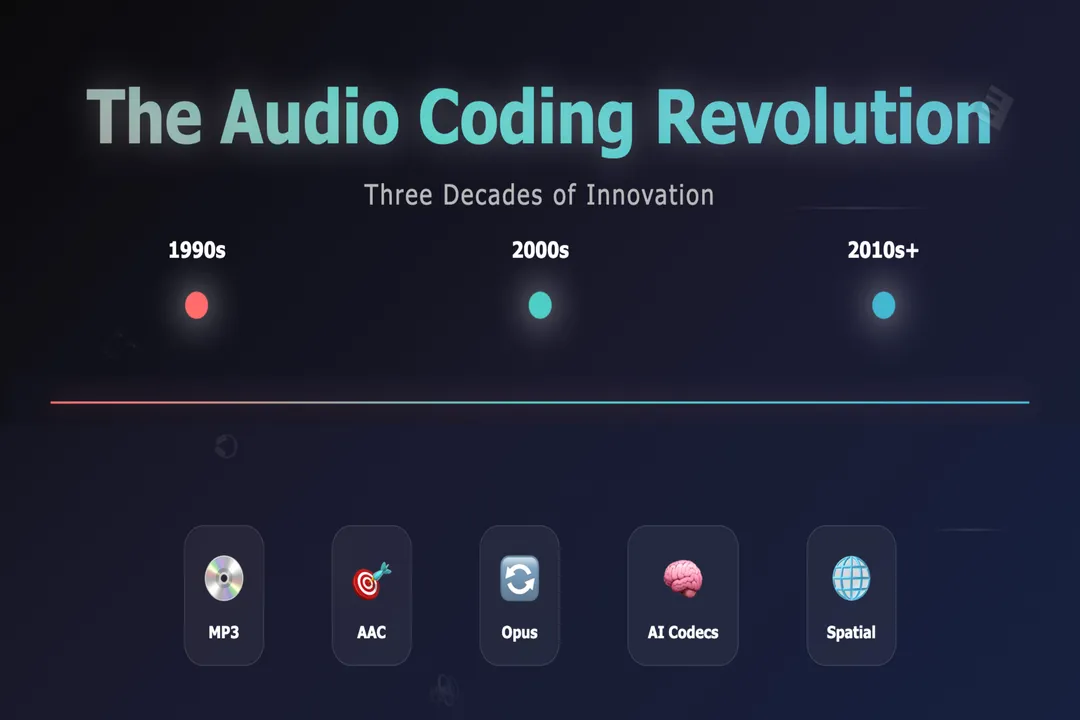
The story of who invented audio codecs is less about a singular "Eureka!" moment and more about a succession of brilliant minds tackling the fundamental problem of making digital sound practical. Before digital formats could be shared easily, they had to be small. This necessity drove the development of audio coding formats, which are sophisticated algorithms designed to compress digital audio data while preserving perceived quality. [1] The true breakthroughs often occur when engineers stop trying to perfectly recreate the source audio and instead start designing around the limitations of human hearing.
# Early Concepts
The quest to store and transmit sound efficiently stretches back to the very beginnings of sound recording itself. [8] However, the modern definition of an audio coding format centers on lossy compression—intelligently discarding information we cannot hear. This is a far cry from earlier digital methods that focused purely on lossless reduction or simple digitization. [8] The general category of audio coding formats is broad, encompassing everything from simple speech codecs to those used in high-fidelity music distribution. [1] The path to today’s streaming standards is paved with decades of work in signal processing and psychoacoustics, long before the music industry felt the digital shift.
# The Mastermind
When most people ask about the inventor of audio codecs, they are usually thinking about the format that revolutionized music distribution: the MP3. In this context, the central figure is unmistakably Karlheinz Brandenburg. [4] He is widely regarded as the mastermind behind the MP3 format. [4] This groundbreaking work was conducted primarily at the Fraunhofer Institute for Integrated Circuits (IIS) in Germany. [2][6]
Brandenburg and his team were developing what eventually became MPEG-1 Audio Layer III. [6] This format formalized the use of psychoacoustic models to achieve significant compression ratios. It wasn't simply about cutting the sample rate or bit depth; it was about understanding what the human ear actually perceives. [6] The goal was to create a format where the discarded data was acoustically insignificant to the average listener. The development process was lengthy, culminating in a format that truly changed how music was consumed and shared globally. [2][10] The 30th anniversary of this technology's core principles has recently been marked, highlighting its enduring influence. [2]

# Standardization Body
While Brandenburg provided the core engineering genius, an invention only becomes a ubiquitous standard when it is formalized for global use. The MP3 format owes its widespread adoption, in part, to the Moving Picture Experts Group (MPEG), the standards body that officially adopted the algorithm as part of the MPEG specification. [6] This standardization process ensured interoperability—a file encoded by one system could be reliably decoded by another, which is critical for any successful technology. [6]
It is an important distinction that while Brandenburg is the inventor of the core technology, the standard is a product of collaborative international standardization efforts, often involving trade-offs and consensus building among many parties. [5] This collaborative aspect often contrasts with the initial, concentrated research effort. For instance, early digital audio history shows many proprietary compression schemes that failed precisely because they lacked broad standardization, proving that standardization itself is as crucial an invention as the algorithm. [8]
# Format Evolution
The revolution Brandenburg helped spark did not stop with MP3. In fact, the principles established were built upon for newer, more efficient codecs. [10] The move from compressed music files on portable devices to the dominance of online streaming required continuous innovation in audio coding. [3] Modern streaming services rely on codecs optimized for real-time delivery and even lower bitrates than what MP3 typically achieved, though often retaining the psychoacoustic foundation. [3] The landscape evolved to include formats like AAC, Ogg Vorbis, and proprietary solutions designed to handle the demands of the internet age. [1][3]
When looking at the timeline, the development of these newer standards shows a clear trajectory: increasing efficiency without sacrificing the perceived quality standard set by MP3. For example, if the original goal was fitting an entire album onto a small hard drive, the modern goal is ensuring flawless playback across variable bandwidth connections—a different engineering challenge solved by continuous codec iteration. [10]
| Format Generation | Primary Goal | Key Concept | Development Era |
|---|---|---|---|
| Early Digital Audio | Storage/Transmission | Sampling/Quantization | Pre-1990s |
| MP3 (MPEG-1 L3) | Efficient Music File | Psychoacoustic Modeling | Early-Mid 1990s |
| Modern Streaming Codecs | Real-time, Low Latency | Optimized Bit Allocation | 2000s - Present |
The success of MP3 spurred not only competition but also deeper academic research into perceptual coding, meaning the initial invention directly funded and motivated the next wave of inventors and engineers. [1]

# The Inventor's Stance
An interesting facet of this history involves the inventor's perspective on the lasting impact and commercialization of his creation. Brandenburg has publicly advocated for the importance of open standards in technology. [5] He has noted that ensuring open standards prevail is vital for the long-term success and equitable access to technology that deeply affects culture, such as audio compression. [5] This viewpoint suggests that for an invention to truly serve the public good, its underlying mechanisms must remain accessible and not be unnecessarily locked down by proprietary licensing, a lesson perhaps learned from the complex commercial path of the MP3 standard itself. [5]
Considering the sheer scale of music that has passed through MP3, it is remarkable to think that the initial work at Fraunhofer IIS aimed at making digital audio smaller for things like digital broadcasting and archival storage, long before it became the default way the world listened to music on personal devices. [6] The inventors were focused on technical feasibility, but the market—the general public accessing music files over early, slow internet connections—defined the technology's ultimate meaning. This gap between the inventor's initial purpose and the technology's eventual application is a recurring theme in technological history. [8]
# Licensing and Adoption
The mechanism by which audio codecs are adopted involves complex intellectual property considerations. While Brandenburg championed openness, the structure surrounding patents and licensing fees for MP3 became a significant factor in its commercial life. [5] This created an environment where newer, often patent-free or more openly licensed alternatives, like Ogg Vorbis, gained traction in certain circles, even if they never fully unseated the ubiquitous compatibility of the established standard. [1] For instance, while a developer might prefer a newer, theoretically superior codec for a new application, the installed base—the sheer number of devices and software that must support MP3—often dictates backwards compatibility requirements, effectively keeping the older format relevant decades later. [10]
The decision to adopt a codec today often hinges less on pure compression ratio and more on patent status and native operating system support. An engineer building a new service must weigh the marginal gain of a newer format against the near-universal reach of established standards. This balancing act is the ongoing reality created by the pioneers who first cracked the code of efficient audio storage. [3]

# Concluding Thought
The history of audio codecs confirms that invention is iterative. While Karlheinz Brandenburg and the team at Fraunhofer IIS deserve recognition as the architects of the format that defined an era through its reliance on psychoacoustic modeling, [2][4][6] they built upon earlier research into sound recording and signal processing. [8] The true "inventor" of the modern audio codec, therefore, is a collective—a lineage of researchers extending from the earliest digital experiments through the standardization committees and into the modern engineers constantly refining the mathematical models of human hearing. [1][10] The legacy rests not just in the creation of the MP3 file but in establishing the very engineering discipline of perceptual coding that continues to drive innovation in streaming and digital media today. [3]
Related Questions
#Citations
Audio coding format - Wikipedia
30 Years of .mp3: Three Letters That Changed the World
A History of Streaming CODECS
Karlheinz Brandenburg, the mastermind behind the MP3 format ...
'Make sure that open standards prevail,' says inventor of MP3 audio
mp3 and more - Google Arts & Culture
Development - The mp3 History
Codec licensing: Applicable intellectual property rights - swart.law
The Audio Coding Revolution: Part 1 - Series 1 - Ferncast