When was the cigarette machine invented?
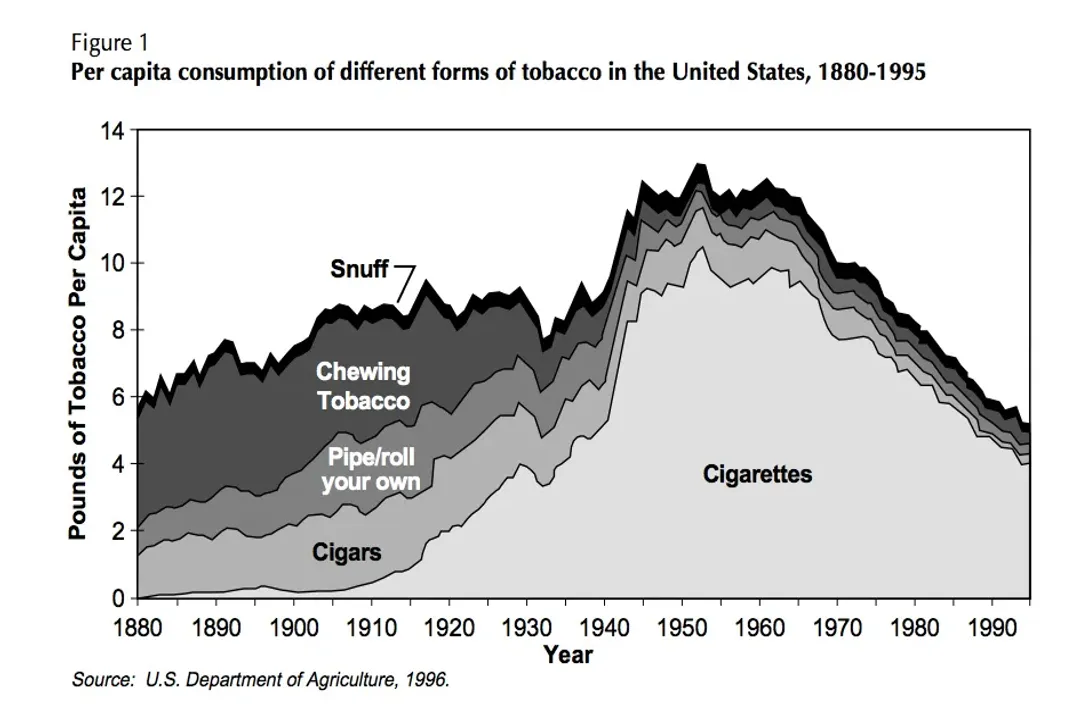
The process of making a cigarette before the late nineteenth century was inherently slow, tethered strictly to the speed and stamina of human hands. Before mechanical assistance, rolling cigarettes was a painstaking task, requiring significant manual skill to create a consistent product that burned evenly. A dedicated, experienced hand roller might manage to produce perhaps four or five cigarettes every sixty seconds. [3][4] This bottleneck in manufacturing capacity severely limited the market potential for cigarettes, keeping them either a niche or luxury item, or one that required massive, dispersed manual labor forces to meet any significant demand. [4]
# The Inventor

The person credited with shattering this production ceiling was James Albert Bonsack. [1][2][7][8] Hailing from Roanoke County, Virginia, Bonsack held the distinction of being an inventor whose creation fundamentally altered an entire consumer industry. [8] His vision was clearly focused on solving a very tangible industrial constraint: the output rate of tobacco preparation. [4] This kind of focused problem-solving, aimed at achieving radical efficiency gains in a specific trade, often characterizes the most impactful historical inventions, even if the inventor himself remains less known than the industry he transformed. [5]
# Patent Timeline

Bonsack’s efforts culminated in a machine that automated the delicate process of cutting the paper, filling it with tobacco, and rolling the finished product. Records indicate that the work leading to his seminal device was patented in 1880. [7] The official grant of the patent followed shortly thereafter, securing his rights to the mechanism around 1881. [3] When the machine finally became operational, it represented an almost unimaginable leap in productivity for the tobacco industry. [3]

# Production Leap

The raw numbers detailing the machine’s performance provide the best measure of its revolutionary impact. Where a skilled worker struggled to clear five units per minute, Bonsack’s invention could churn out two hundred cigarettes every minute. [3][4][5] To put that into context, a single machine operating for one shift could conceivably produce the equivalent output that would have required forty dedicated hand-rollers working constantly, assuming the hand-rollers maintained their average rate. This sheer multiplicative factor—a 40x increase in output potential from a single mechanized unit—meant that for the first time, mass production of cigarettes became economically feasible on an unprecedented scale. [3][4] This single invention essentially industrialized the cigarette, shifting it from a craft item to a commodity. [5]
# Industry Reshaping
The introduction of high-speed rolling machinery immediately favored large capital investors over small operators. Companies that could afford to purchase, install, and operate these expensive new machines gained an insurmountable cost advantage. [5] The most famous beneficiary of this new technological capability was James Buchanan "Buck" Duke. [5] Duke successfully built his empire, the American Tobacco Company, by capitalizing on the massive output potential unlocked by the Bonsack machine, allowing him to flood markets with cheap, consistently manufactured cigarettes. [5] It wasn't just about producing more; it was about producing them cheaply enough to drive down prices and capture market share that was previously inaccessible due to manual labor costs.
While the machine solved the production rate problem, it inadvertently created a new set of labor dynamics. The need for low-skilled, fast hand-rollers diminished significantly, replaced by a demand for workers who could tend the machines, maintain their intricate mechanisms, and ensure the continuous supply of materials like paper and tobacco filling. [4] This change represented a clear shift in factory employment: the value moved away from manual dexterity in assembly to technical proficiency in operation and maintenance, subtly redefining what constituted 'skilled labor' within the tobacco factory setting. [4] Furthermore, the early machines, while fast, were complex; they featured rolling tables and specific mechanisms that still required specialized understanding to keep running smoothly, preventing total elimination of the need for specialized staff. [4]

# Components and Operation
The basic principle behind the Bonsack machine involved automating the steps previously done by hand. This included the accurate feeding of tobacco onto a paper strip. [4] The machine would then wrap or "roll" this paper around the tobacco filler before sealing it, all in a continuous, high-speed motion. [4] One description of the mechanism highlights a rolling table that worked in conjunction with the rest of the apparatus to achieve the tight, consistent roll necessary for a good product. [4] The fact that such a complex mechanical solution could be reliably implemented in the 1880s, a relatively early period for high-speed automated manufacturing, speaks volumes about the ingenuity applied to solving this particular industrial challenge. [3][7]
# Enduring Impact
The Bonsack machine did more than just speed up manufacturing; it set the foundation for the modern cigarette industry as we know it, for better or worse. [5] It standardized the product and facilitated the advertising campaigns that followed, as manufacturers could now guarantee supply to match any promotional push. [5] Without this mechanical precursor, the scale of global tobacco consumption and the resulting public health crises of the 20th century would likely have developed along a drastically different, slower path, constrained by the physical limitations of human workers. [7] The machine is a prime historical example of how an efficiency breakthrough in one sector can radically alter societal consumption patterns across the board.
#Videos
The Cigarette machine: the invention with the greatest ... - YouTube
Related Questions
#Citations
James Albert Bonsack - Wikipedia
James Albert Bonsack (4 October 1859-2 June 1924) Biography
What everyone gets wrong about the history of cigarettes - Vox
The Bonsack Machine and Labor Unrest - NCpedia
Buck Duke, Roller Skates, And Cigarettes - How One Machine ...
The Cigarette machine: the invention with the greatest ... - YouTube
Who Invented the Cigarette? A History of Tobacco Smoking and ...
May is #NationalInventorsMonth.... - Library of Virginia - Facebook
1900 – 1919 The Beginning | History of Tobacco Policy
Bonsack Cigarette Rolling Machine - Flickr