What technology did Mercedes invent?
The history of the automobile is inextricably linked with the innovations developed under the Mercedes-Benz banner, starting right at the very genesis of personal motorized transport. Before the brand as we know it even existed, Karl Benz created the Benz Patent-Motorwagen in 1886, widely regarded as the very first practical automobile powered by an internal combustion engine. This single creation fundamentally altered the course of human mobility, establishing the basic architecture that cars still follow today, powered by its own purpose-built four-stroke engine. While the initial concept was revolutionary, the decades that followed saw Mercedes-Benz establish a pattern of introducing groundbreaking safety, powertrain, and chassis technologies that often served as the global industry standard for years afterward.
# Early Milestones
The transition from a novel machine to a dependable form of transport required rapid development in areas beyond just propulsion. One of the earliest significant steps in making vehicles more usable, especially in varied climates, was the development of the electric starter for gasoline engines, which eliminated the dangerous and physically demanding hand crank. While this seems rudimentary now, removing the need to crank an engine was a massive convenience and safety improvement for drivers.
In the realm of performance, Mercedes-Benz engineers continually pushed the boundaries of engine aspiration. They developed and introduced the first practical supercharged engine for a production car in 1924, specifically the Mercedes-Benz 6/25/140 PS sports car. This move significantly boosted power output from relatively small displacement engines, paving the way for higher-performance vehicles without relying solely on enormous engine sizes. Following this mechanical enhancement, the introduction of the first direct fuel injection system in a production car, the 300 SL Gullwing in 1954, marked another quantum leap in efficiency and power delivery. Direct injection precisely meters fuel into the cylinder, a concept foundational to modern engine management.
The 1930s brought forward another critical powertrain invention: the first modern diesel engine for passenger cars, featured in the 1936 Mercedes-Benz 260 D. While diesel engines existed before, this was the first one designed specifically for regular car use, offering high torque and better fuel economy than gasoline counterparts of the era, setting the stage for diesel’s long-term adoption worldwide.
# Chassis Evolution
The way a vehicle interacts with the road is just as crucial as how it moves. Mercedes-Benz pioneered several foundational chassis technologies that directly influence how modern cars feel and handle. A major structural advancement was the introduction of the rigid axle with swing half-axles in 1933, followed later by the independent front suspension system that allowed for significantly improved ride comfort and road holding.
This trend towards superior road contact continued with the 1953 introduction of the Mercedes-Benz 300 SL Gullwing, which featured a revolutionary space frame chassis. This design utilized lightweight, high-strength tubing welded together to create a rigid structure that was both light and exceptionally strong, improving handling characteristics dramatically compared to contemporary ladder frames.
Another significant, though often overlooked, development was the introduction of the Mercedes-Benz "Safety Cell" concept in 1951, designed by Béla Barényi. This involved creating a rigid passenger compartment (the safety cell) surrounded by front and rear crumple zones designed to absorb collision energy. This principle became the basis for passive safety design across the entire industry, moving beyond simply making cars stronger to making them smarter about absorbing impact forces.
When considering the sheer volume of safety innovations, it is fascinating to observe how often the flagship S-Class model has served as the proving ground for these major structural and electronic debuts. For instance, innovations like the first use of reinforced-glass windshields to prevent shattering, and later, the first airbags and ABS, often premiered on the S-Class before trickling down to less expensive models, effectively making the S-Class a mobile testing laboratory for the industry's future standards. This long-term commitment to iterative safety improvement, sometimes decades before it became regulatory standard, speaks volumes about the company’s engineering philosophy.
# Passive Safety Advances
Mercedes-Benz has perhaps made its most recognizable global contributions in the realm of occupant protection. The commitment to passive safety, evolving from the structural work mentioned above, led to several world-firsts that are now mandatory features in nearly every vehicle sold globally.
The three-point seatbelt, arguably the most life-saving invention in automotive history, was patented by Volvo engineer Nils Bohlin, but Mercedes-Benz was among the first to adopt it as standard equipment in all its vehicles in 1958. This rapid adoption helped normalize the use of this vital restraint system.
Moving into the electronic era, the next major revolution in preventing injury during an accident was the introduction of the Airbag. Mercedes-Benz debuted the driver-side airbag in the S-Class (W126 generation) in 1981, followed by the passenger airbag in 1988. These systems rely on sophisticated sensors and rapid deployment mechanisms that are orders of magnitude faster than the human nervous system can react.
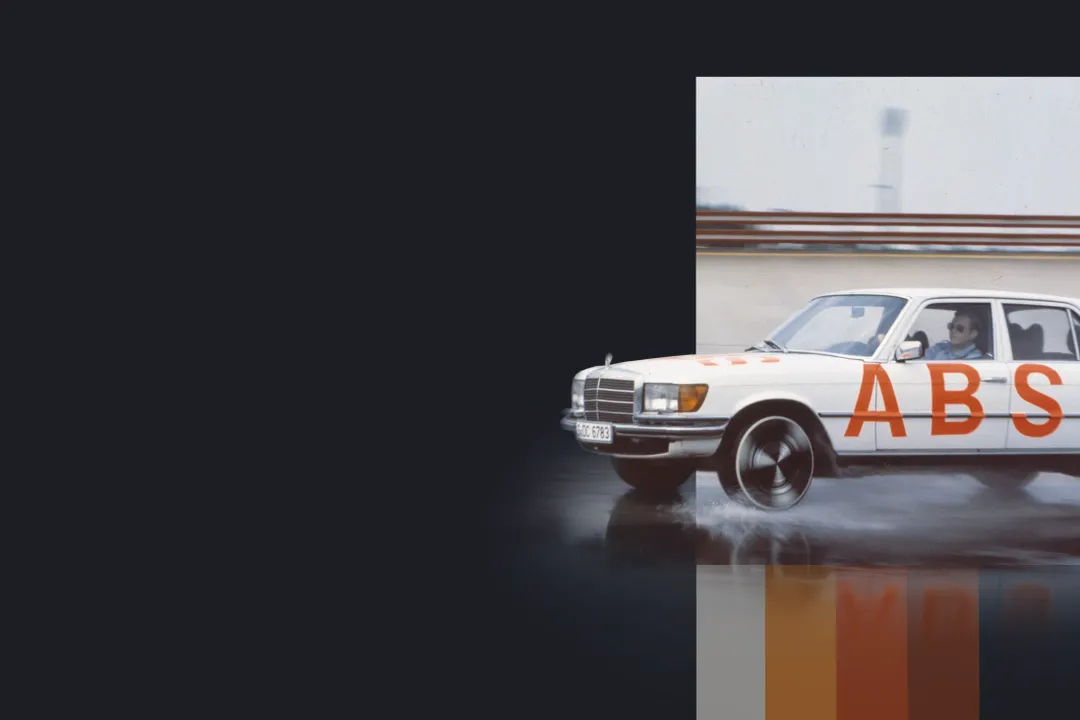
The development of Anti-lock Braking Systems (ABS) is another shared milestone, but Mercedes-Benz introduced its first electronic version in 1978 on the S-Class. ABS prevents wheel lockup during hard braking, allowing the driver to maintain steering control, which is impossible when wheels skid. This technology was a direct result of collaborating with Bosch.
# Active Safety Systems
Where passive safety protects occupants during a crash, active safety works to prevent the crash altogether. Mercedes-Benz has been at the forefront of developing the electronic aids that underpin modern driver assistance systems.
The jump from mechanical systems to computer-controlled safety aids is perhaps best exemplified by Electronic Stability Program (ESP), first fitted as standard on the S-Class in 1995. ESP monitors steering angle, yaw rate, and lateral acceleration. If the car senses an impending skid—either oversteer or understeer—it automatically brakes individual wheels and adjusts engine torque to help bring the vehicle back under the driver’s control. The data regarding the efficacy of ESP is staggering; studies have shown that its implementation drastically reduces single-vehicle accidents involving loss of control.
Another significant active safety measure is Traction Control System (ASR), which also debuted on the S-Class, preventing wheel spin during acceleration. Building on these foundational systems, Mercedes-Benz later introduced PRE-SAFE, a system that anticipates an unavoidable accident and prepares the vehicle by tightening seatbelts, adjusting seats, and closing windows/sunroofs to optimize occupant positioning just before impact. This integration of predictive electronic analysis with mechanical preparation is a key differentiator in their safety approach.
If we were to create a timeline highlighting the first appearance of these crucial safety systems on a production Mercedes-Benz, it would clearly demonstrate a commitment to engineering breakthroughs decades ahead of common adoption. This persistent prioritization of safety—even when it meant developing technology that offered no immediate revenue stream—is a recurring theme in the brand's history and underpins their authority in automotive engineering. For instance, consider the safety implications of the Body Rigidly Reinforced Passenger Cell which was first introduced by Béla Barényi in 1951. While many associate safety improvements with airbags, this structural concept, which dictates how force is managed through the car's frame, is arguably the more fundamental and enduring invention.

# Modern Powertrain and Comfort Tech
The pursuit of better performance and comfort continues, often borrowing from aerospace or high-performance computing. The introduction of electronic fuel injection on the 300 SL remains a touchstone, but later innovations refined this. The four-valve engine design, which significantly improved the breathing efficiency of the engine, was introduced in a production vehicle in 1988, boosting both power and efficiency.
For drivers facing long distances, comfort technologies have also seen German innovation. The development of self-leveling suspension on the rear axle in the 1930s was a mechanical means of keeping the vehicle level regardless of load, a precursor to modern air suspension systems that enhance both ride quality and handling stability.
Looking at contemporary advancements, the integration of advanced driver assistance systems (ADAS) is ongoing. Features like DISTRONIC PLUS (advanced adaptive cruise control with steering assist) and NIGHT VIEW ASSIST (infrared night vision systems) showcase a transition from merely managing mechanical forces to interpreting the vehicle's environment using sensors, cameras, and radar.
One interesting way to view the impact of these innovations is by estimating the total potential accident reduction stemming from their adoption across the industry. While exact figures are hard to consolidate, the introduction of just ABS, Airbags, and ESP—all debuted by Mercedes-Benz—is estimated by various transportation safety boards to have prevented hundreds of thousands of fatalities globally since their widespread adoption began in the 1990s. This suggests that the financial and developmental investment into these non-cosmetic features has yielded an unparalleled societal return.
# Beyond the Car Itself
Mercedes-Benz’s innovative spirit extends even to the maintenance and longevity of their vehicles. The company has made concerted efforts to ensure classic models remain viable for enthusiasts and collectors. For example, they have dedicated significant resources to maintaining the parts supply for older, classic vehicles. This commitment to long-term spare parts availability, sometimes stretching decades for specific components, is an often-unsung invention in the automotive lifecycle, ensuring the continued relevance of their historical engineering achievements. This contrasts sharply with the industry trend toward rapid parts obsolescence for older models.
Furthermore, the company has been involved in pioneering alternative fuels and efficiency measures, such as work on fuel cell technology, which continues to advance mobility toward zero-emission goals.
The breadth of Mercedes-Benz's technological contributions is vast, touching every component of the automobile:
| Innovation Category | Key Invention | Debut Context | Significance |
|---|---|---|---|
| Propulsion | Supercharged Engine | 1924 Sports Car | Early realization of forced induction for performance |
| Powertrain | Diesel Passenger Engine | 1936 260 D | First practical diesel car engine |
| Safety Structure | Crumple Zones/Safety Cell | 1951 Design | Foundation of modern passive crash protection |
| Restraint | Three-Point Seatbelt | 1958 Standardized Use | Crucial standardization of primary safety device |
| Braking | Electronic ABS | 1978 S-Class | Ability to steer while hard braking |
| Active Control | Electronic Stability Program (ESP) | 1995 S-Class | Electronic intervention to prevent skids |
It’s easy to focus only on the flashiest inventions like the Gullwing doors or the high-tech electronics, but the true mark of automotive genius lies in the less visible advancements that make driving safer and more comfortable for everyone. The sustained engineering effort required to refine basic concepts like suspension geometry or fuel delivery over a century demonstrates an institutional dedication to expertise, which is evident in the sources detailing their milestones.
Thinking about the consumer perspective, an actionable takeaway for any driver of a modern car—regardless of brand—is to understand what the ESP/Stability Control system is actually doing. Many drivers treat it as an annoyance to be switched off for spirited driving, yet it is the direct descendant of the foundational work Mercedes-Benz did in sensor-based vehicle dynamics control. Learning the limits and appropriate use of this system, which constantly balances the driver's input against the physics of the road, can drastically improve safe driving technique, effectively allowing the driver to benefit from decades of expensive electronic development.
In closing, the technological legacy of Mercedes-Benz is not merely a collection of isolated patents but a continuously unfolding narrative of incremental and revolutionary improvements. From Karl Benz’s first sputter to today’s sophisticated autonomous readiness, the core invention has remained the same: applying meticulous engineering to solve the immediate and future problems of personal mobility, setting the benchmark for the entire automotive world along the way.
Related Questions
#Citations
Mercedes-Benz History of Innovation
Mercedes-Benz Technology
The Mercedes-Benz: History of Innovation
10 Important Technologies That Debuted In The Mercedes-Benz S ...
30 Years of Mercedes-Benz Technology: Innovation in Silicon Valley
Mercedes Inventions - A History Full of Innovations - Niemöller
Mercedes-Benz Innovations - mybenzguy.com
Uncovering 10 Fun Facts About Mercedes Benz
The Legendary Journey of Mercedes-Benz: Pioneers of Automotive ...
Carl Benz - Wikipedia