How did Theodore Maiman invent the laser?
The invention of the laser was not a single bolt of lightning but the culmination of several deep theoretical breakthroughs, yet the physical realization of that concept rests squarely on the shoulders of Theodore H. Maiman. [2][5] In the late 1950s, the scientific world was buzzing with the concept of coherent light amplification, a phenomenon rooted in Albert Einstein’s early 20th-century theory of stimulated emission. [3] While the foundation was laid by pioneers like Einstein, the immediate precursor to the laser was the maser—the microwave equivalent—developed by Charles Townes and his colleagues. [1][3]
# Theoretical Base
The idea of creating an optical maser, which would later be dubbed the laser (Light Amplification by Stimulated Emission of Radiation), was actively being pursued by several major research groups. [3][5] Charles Townes, whose work on the ammonia maser was seminal, along with Arthur Schawlow, had published a paper in the Bell System Technical Journal in 1958 outlining the physics and proposing an optical resonator design necessary for such a device. [1][3] Townes’s early thinking was heavily invested in gas systems as the active medium for this light amplification. [1] This theoretical groundwork provided the essential physics—the need for a population inversion within a suitable material and a resonant cavity to bounce the light back and forth, forcing more and more atoms to emit coherent photons—but it did not provide the working hardware. [3]
# Hughes Pursuit
Theodore Maiman joined Hughes Research Laboratories (HRL) in 1960. [7] HRL was focused on developing lasers, seeing the potential technology as a significant advancement. [7] Maiman entered this highly competitive environment, keenly aware that a breakthrough was imminent. [3][5] While others, notably Gordon Gould, were working on gas lasers and had even coined the acronym LASER, Maiman took a different, more direct path based on material selection. [3][5] The search for the right active medium became the critical challenge separating theory from tangible reality. [1]
# Material Selection
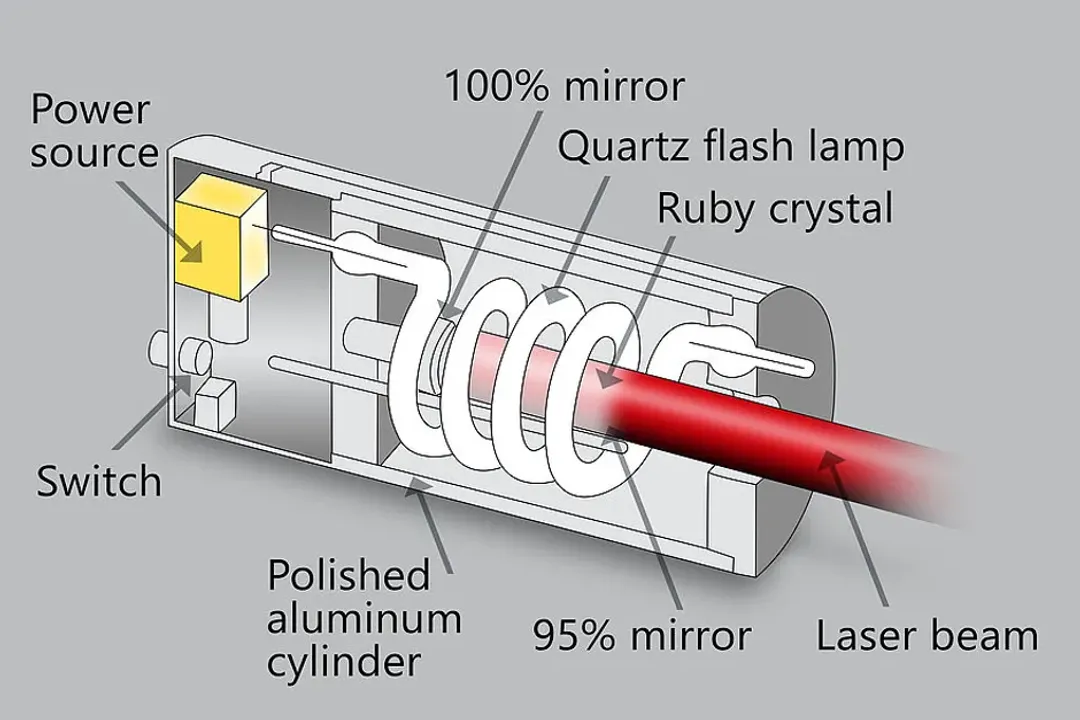
Maiman’s genius lay in his choice of material, diverging from the gas systems that many of his contemporaries, including Townes, were focusing on. [1] He concentrated his efforts on solid-state devices. [6] After investigating several possibilities, Maiman settled on a synthetic ruby crystal rod. [2][5][6] Specifically, this rod was aluminum oxide doped with chromium ions (). [2][5] The chromium ions served as the necessary active centers that could be excited to create the required population inversion. [2]
The selection of ruby was critical. It possessed the necessary three-level energy structure required for laser action, and the specific doping concentration was crucial for successful operation. [6] This choice positioned him ahead of the pack, which was stalled by the difficulties inherent in building the first effective gas lasers capable of achieving sufficient light amplification. [3] The elegance of Maiman's first device—a simple, albeit high-powered, flash-pumped solid-state setup—contrasts sharply with the more complex, continuous-wave gas systems that dominated subsequent commercial applications for a time. This highlights the value of material science focus over system complexity in achieving a first demonstration. [1]
# Building the Machine
Once the ruby crystal was chosen, Maiman needed a way to pump energy into it—to excite those chromium ions from their ground state to a higher energy level, creating the population inversion needed for light amplification. [2][6] For this, he did not use a continuous light source, but rather a very intense, brief pulse of energy. [2]
The pumping source was a high-intensity photographic flash lamp wrapped around the ruby rod. [2][5] The flash lamp provided the massive surge of energy required to push the laser medium across the necessary threshold for lasing. [6]
The optical cavity was formed by coating the ends of the ruby rod itself. [2] One end was coated to be highly reflective, acting as the primary mirror, while the other end was coated to be partially transmissive, allowing some of the amplified, coherent light to escape. [2] This setup was relatively straightforward compared to the intricate mirror systems later required for stable, high-power resonators, demonstrating a pragmatic engineering approach to realizing the theory. [3] Considering the technology of the late 1950s, the sheer electrical energy required by the photographic flash tubes to excite the ruby to the lasing threshold represents a massive engineering feat given the contemporary power supply limitations, making the achievement even more impressive than a modern textbook schematic suggests. [2]
# The First Light
The defining moment arrived at Hughes Research Laboratories in Malibu, California. [6] On May 16, 1960, Theodore Maiman successfully operated the first functional laser. [2][5][6]
When the flash lamp fired, the stimulated emission occurred within the ruby rod. The resulting light was not a typical beam; it was a series of short pulses, but crucially, the light emitted was coherent—all the photons were traveling in phase. [3] The color of this revolutionary light was red, corresponding to a wavelength of approximately 694.3 nanometers (). [2][6] Maiman’s success proved that a solid-state material could be made to lase, a monumental step forward from the theoretical stage. [3]
# Competition and Recognition
The race to the first laser was intense. [3] Maiman’s success came very shortly after he began testing the ruby system. [5] While Gordon Gould had developed the theoretical concepts and even coined the acronym LASER in 1957, Maiman was the first to build and demonstrate a working model. [3][5] This practical demonstration quickly validated the physics in a tangible way that theoretical papers could not match. [3]
Maiman’s demonstration was met with initial skepticism in some scientific circles, partially because the ruby laser produced pulsed output rather than the continuous wave (CW) output that some researchers, still focused on gas systems, considered the ultimate goal. [5] However, the achievement was undeniable. The U.S. Patent Office eventually granted Patent 3,353,111 for the laser to Maiman in 1967. [5] While he received many accolades, some accounts note that the immediate recognition for his pivotal work sometimes lagged behind the publicity given to other figures in the field, such as Townes. [1]
# Later Developments
Following his initial breakthrough, Maiman continued to contribute significantly to the development of laser technology. [5] He went on to build the first working helium-neon gas laser later that same year, demonstrating the viability of a different type of active medium. [5] This early work on gas systems showed his versatility and commitment to advancing the technology beyond the initial solid-state success. [5] The core principles established by Maiman, involving the pumping source, the gain medium, and the optical cavity, remain the fundamental building blocks of nearly every laser invented since that historic day in 1960. [3][6]
The invention of the laser itself represented a scientific milestone, but its eventual impact across medicine, manufacturing, telecommunications, and data storage confirms its status as one of the most important inventions of the 20th century. [4] The quiet, focused work of Theodore Maiman, centered on a specific mineral, unlocked a power source that continues to shape modern life. [2][7]
#Videos
The world's first laser was successfully operated by Theodore Maiman
Related Questions
#Citations
The first laser - The University of Chicago Press
Theodore Maiman - Wikipedia
Physics History | American Physical Society
Bright Idea: The First Lasers - American Institute of Physics
Theodore Maiman and the Laser
History of laser technology
About | The Laser - HRL Laboratories
The world's first laser was successfully operated by Theodore Maiman
Laser - DPMA