Who invented the highway system in the world?
The genesis of the modern, high-speed highway system is not traceable to a single inventor or a specific year, as road construction is an ancient human endeavor. However, when people discuss the invention of the system—meaning large-scale, interconnected, controlled-access motorways designed for rapid transit—the focus often zeroes in on the mid-20th century United States and the vision that created the Interstate Highway System (IHS). [2][4] This undertaking became the largest public works project in history. [2][4]
# Convoy Experience
The critical spark for President Dwight D. Eisenhower’s dedication to such a network came from direct, challenging experience. In 1919, as a young Army officer, Eisenhower participated in the first military transcontinental motor convoy across the United States. [2][5][6] This journey, involving roughly 80 vehicles traveling from Washington D.C. to San Francisco, highlighted the profound inadequacy of existing American roads for mechanized military movement. [2][5] The trip was arduous, slow, and frequently interrupted by poor road conditions, taking over two months to complete. [5][6] This practical exposure demonstrated to Eisenhower the sheer logistical vulnerability of a nation relying on primitive surface roads. [2]
# Foreign Observation
Eisenhower’s perspective was further shaped by observing European road infrastructure while serving as the Supreme Commander of the Allied Expeditionary Force during World War II. [6] Specifically, he was impressed by the German Autobahn system. [1][5][6] These German expressways were designed for high-speed, limited-access travel, serving both civilian and military transport needs effectively. [5] Seeing a fully functional, high-capacity network in action provided a tangible model for what the U.S. might achieve, contrasting sharply with the frustrating convoy experience of two decades prior. [6]
# Political Architect
While Eisenhower provided the impetus and the political will, the planning and technical expertise for a national system predated his presidency and involved key figures who laid the groundwork over many years. [3] One essential figure in this background work was Thomas H. MacDonald, who served as the Chief of the Bureau of Public Roads for many years. [3] MacDonald’s bureau was instrumental in advocating for and designing federal-aid road programs long before the 1950s. [3] Even earlier considerations, such as the 1941 Board Road Report, had outlined the need for an extensive network, though wartime priorities delayed action. [6] It is worth noting the nearly four-decade gap between Eisenhower's formative convoy experience in 1919 and the signing of the enabling legislation in 1956. This lag illustrates that while the need was identified early on, the political climate—especially the perceived threat of the Cold War—was necessary to galvanize the massive federal investment required to move beyond disparate state-run road projects into a unified national system. [3]
# Legislative Birth
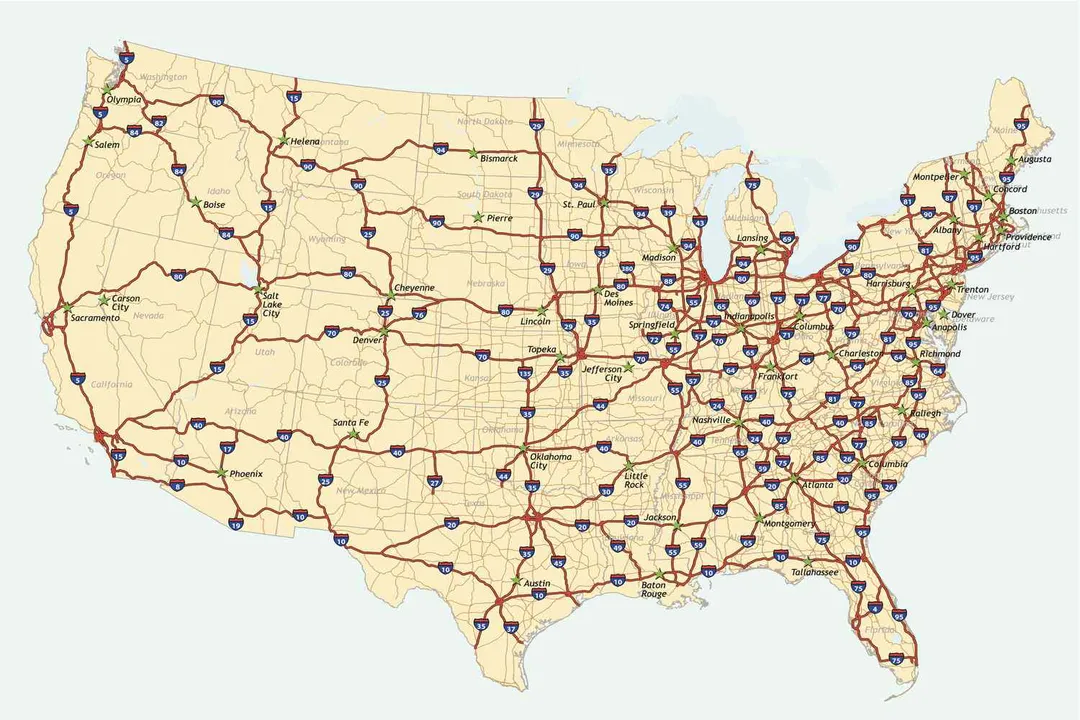
The official birth of the Interstate Highway System as we know it occurred with the signing of the Federal-Aid Highway Act of 1956. [1][2][4] President Eisenhower signed this landmark legislation, which authorized the construction of the 41,000-mile network. [1][2][4] This act was not merely an incremental funding bill; it established a massive, federally directed project with an initial authorization of $$25$ billion for the first 13 years of work. [4][5] The funding mechanism was also revolutionary, relying significantly on dedicated federal taxes, ensuring that the project was shielded, to an extent, from annual appropriations battles. [4]
# System Design
The system wasn't just about laying pavement; it involved setting national standards that elevated construction quality far beyond typical state routes. [4] The design specifications mandated features like minimum lane widths, gentle curves, limited grades, and grade separation (overpasses or underpasses) at all intersections. [4] This focus on high-speed, uninterrupted traffic flow is what truly defined it as a modern "system" rather than just a collection of roads. [1]
The stated purpose of the act included both civilian and military aims. While improving commerce and reducing travel times were clear benefits, the national defense aspect was heavily emphasized. [3] The system was specifically designed to allow for the rapid, efficient movement of troops and materiel across the nation, especially in the context of potential nuclear threats during the Cold War era. [3]
# Economic Transformation
The creation of a unified, high-capacity road network fundamentally reshaped the American economic and social geography. [5][6] Before the Interstates, large-scale trucking was often limited by state-to-state variances in road quality, weight restrictions, and access regulations. [6] The IHS provided a standardized backbone that allowed freight to move faster and cheaper than ever before. [6]
Thinking about the structure of this investment, it's noteworthy that the federal government bore 90% of the cost for the Interstate System construction, a proportion far exceeding previous federal contributions to road building. [4] This massive federal assumption of cost signaled a shift in responsibility, treating national connectivity as a defense and commerce imperative rather than solely a local or state concern. This federal underwriting allowed for the construction of routes that might have been deemed too expensive or politically complex for individual states to undertake on their own, especially through dense urban corridors. [1]
# Dispelling Assumptions
It is a common misconception that the Interstate System was solely the brainchild of Eisenhower or that its only goal was to help family vacationers reach tourist destinations. [3] While Eisenhower championed it, the planning foundation was laid by engineers like MacDonald. [3] Furthermore, the primary initial justification often cited by proponents was defense, not leisure travel. [3]
Another aspect to consider is the way the system interacted with existing infrastructure. The construction often involved federal seizure of land through eminent domain, cutting through established neighborhoods and fundamentally altering urban landscapes in ways that are still analyzed today. [5] The building process itself was a massive engineering feat, frequently involving bridges, tunnels, and cuts through difficult terrain across the entire country. [2]
While the German Autobahn served as the inspiration for the design standards, the scope and funding mechanism of the US Interstate System set a new global benchmark for integrated national road networks in the post-war era. [1][5] The sheer magnitude of the project—creating tens of thousands of miles of brand-new, controlled-access road—is what often leads historians to point to the 1956 legislation as the defining moment for the modern highway system, even if the concept of building roads predates it by millennia. No single "inventor" can claim the roads themselves, but Eisenhower and the planners behind the 1956 Act certainly "invented" the modern, federally coordinated blueprint for highway travel in the United States. [2][3]
# Global Context and Comparison
When considering the world, it is important to differentiate between the first paved roads (ancient empires like Rome) and the concept of a nationally unified, high-speed network. [1] Many nations implemented national road programs in the early 20th century, and France, for example, had its own system of autoroutes developing concurrently or shortly after the German example. [1] However, the US IHS remains the largest single example of such a system ever constructed, making it the most frequently cited reference point when discussing the "invention" of the large-scale highway system. [2][4] The American approach—centralized federal funding overriding state boundaries for national strategic benefit—became a model for massive infrastructure development globally, even if the execution and scale differed elsewhere. [6]



#Videos
The Interstate Highway System - YouTube
Related Questions
#Citations
Interstate Highway System - Wikipedia
History of the Interstate Highway System | FHWA
Happy 60th Birthday, Interstate Highway System!
How WWII Created the Interstate Highways - ThoughtCo
Interstate Highway System - Eisenhower Presidential Library
When Interstates Paved the Way - Federal Reserve Bank of Richmond
The Interstate Highway System - YouTube
Who Invented Highways? First Highways and Their Lasting Legacy