Who invented mobile clinics?
The concept of bringing medical care directly to populations that cannot easily reach a fixed facility has no single inventor, but rather represents an evolution across different global needs, from military necessity to rural outreach and specialized emergency response. The genesis of what we now call mobile clinics can be traced through several distinct, often simultaneous, efforts that addressed unique access barriers in the mid-20th century.
# Military Precursors
The initial impulse for creating portable or vehicle-based medical treatment centers often originated within the armed forces. During the Second World War, mobile medical units were first developed for battlefield use. These early iterations were designed to treat soldiers closer to the front lines. However, this specific military application was relatively short-lived, as the need for immediate surgical capacity led to the rapid adoption of the more comprehensive Mobile Army Surgical Hospitals (MASH). Despite their military discontinuation, the fundamental idea of a deployable clinic persisted and soon transitioned into the civilian sector in various countries, including India, Cuba, the UK, and the US.
# Rural Outreach Efforts
One of the earliest and most dedicated civilian initiatives focused on bringing primary healthcare to underserved rural populations took root in India following World War II. This effort was spearheaded by Mrs. Hilda Seligman, who, motivated by gratitude toward Indian soldiers who fought in the war, sought to give back by improving healthcare access for rural Indian women.
Seligman's vision led to the creation of the Village Mobile Health Van Project, coordinated by the All-India Women’s Conference (AIWC). The first health van, nicknamed “Skippo,” began operating near Bombay in 1946. Skippo served as a Primary Healthcare Centre, offering essential services such as immunization, antenatal care, and advice on birth control methods. Crucially, the AIWC strongly advocated for a lady doctor to be onboard whenever feasible. This project, which secured international funding, including support from the New Zealand Council of Organizations for Relief Services Overseas Incorporated (CORSO), grew to encompass nearly a dozen vans by 1957. The enduring success of Skippo highlights that the invention of the mobile clinic was deeply intertwined with philanthropic goals and addressing gendered access issues in remote areas.
It is worth noting the organizational difference here: while the military models prioritized rapid stabilization, the Skippo project exemplified a commitment to sustained, comprehensive primary and preventive care, even featuring dedicated record-keeping and follow-up on lifestyle advice for prevalent issues like anemia—a focus that modern rural MMUs continue to emulate.
# Addressing Urban Access Gaps
Around the same time that Skippo was serving rural India, parallel needs were being addressed in the United States, focusing on socioeconomic barriers within less accessible urban communities. In 1968, in Washington, D.C., Dr. Herman “Arnold” Meyersburg and Dr. George Cohen founded MobileMed. Their initial motivation stemmed from working with poor children whose parents often lacked health insurance, rendering basic healthcare effectively unreachable.
The initial concept for MobileMed was based on collaboration: instead of immediately acquiring vehicles, they sought partnerships where local stakeholders could provide physical space and a clinic registrar, allowing the doctors to focus on medical services. While the organization eventually incorporated mobile medical vans in the years that followed, this founding principle emphasized meeting existing community infrastructure halfway to overcome access barriers related to finance, language, and transportation. This contrasts with the Skippo model, which was built around bringing the facility itself to isolated locations, suggesting that "mobile" care adapts its delivery method based on the primary obstacle—geography versus socioeconomics.
# Specialized Emergency Response
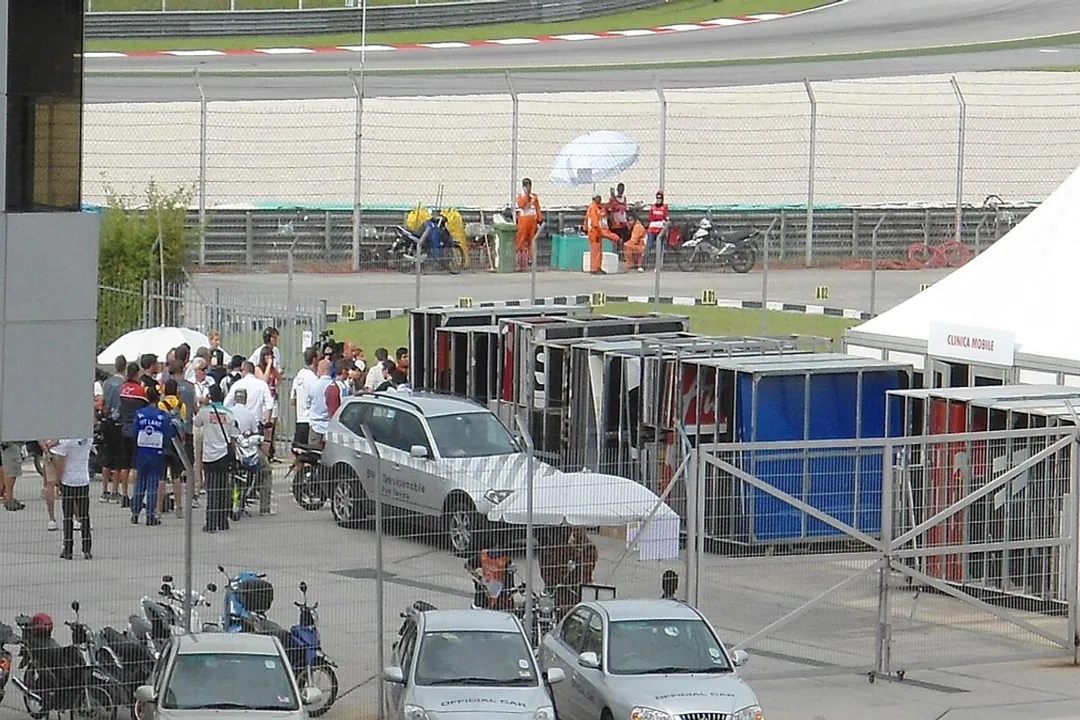
A later, highly specialized iteration of the mobile clinic emerged from the high-stakes world of professional motorsports. In 1976, Dr. Claudio Costa initiated the creation of the Clinica Mobile. This facility was explicitly designed as a medical emergency response unit to provide immediate intervention for riders injured during motorcycle races.
The first vehicle purpose-built for this service debuted in 1977 at a World Championship race. The immediate, trauma-focused nature of this clinic meant its staff had to operate under extreme pressure, sometimes even facing interference while attempting to treat injured athletes trackside. Clinica Mobile became an established fixture on the racing circuit, demonstrating that mobile healthcare units could be custom-engineered for niche, time-critical medical needs rather than solely for general community screening or primary care. While Skippo carried a doctor, nurse, compounder, and driver to manage general wellness, Clinica Mobile represented rapid-response trauma expertise on wheels.
# Evolving Functions and Scope
The divergent histories of these early efforts—military support, rural primary health, urban poverty outreach, and specialized sports medicine—reveal that the definition of a "mobile clinic" is fluid. Its purpose dictates its form.
The functions addressed by these early mobile units illustrate the widening scope of mobile health beyond simple first aid. Skippo provided comprehensive services like antenatal care and immunization, tackling public health issues endemic to isolated areas. MobileMed focused on chronic condition management, acting as a continuous "medical home" for low-income patients dealing with issues like hypertension and diabetes, where consistent follow-up is essential.
From a modern perspective, considering the development of occupational health screening programs provides another angle on this evolution. In some sectors, like occupational health, mobile units have been used for decades to provide essential services like physical examinations and drug testing directly at worksites. This application recognizes that the time cost of travel for routine employer-mandated or preventative health checks is a significant barrier to compliance.
What links all these pioneers is the recognition that the delivery mechanism is as vital as the medical knowledge itself when addressing barriers. The evolution shows a clear move from simple transport of medicine to fully equipped diagnostic centers capable of services like blood tests and ECGs, ensuring early detection of serious conditions in inaccessible settings. The continuous challenge across all models, however, remains resource allocation—securing enough funding and qualified volunteer or staff personnel to sustain the operations, a difficulty noted by MobileMed over fifty years after its founding.
Related Questions
#Citations
History And The Patients We Serve - Mobile Medical Care
Clinica Mobile - Wikipedia
Mobile Medical Units: In History and Beyond - FORRAD