Who invented contamination monitoring?

Tracing the lineage of contamination monitoring reveals not a single 'Eureka!' moment but a continuous, multidisciplinary progression across environmental concerns, industrial safety, and analytical chemistry. The need to detect unwanted substances in our surroundings—be it air or water—drove innovations from basic chemical assessments to sophisticated electronic hardware. There is no single person who can claim the title of inventor for this entire field; rather, it is the cumulative work of engineers, chemists, and regulatory bodies responding to evolving threats.
# Water Control
Historically, monitoring water quality began long before electronic sensors existed, relying heavily on sensory perception and straightforward chemical analysis. Early water quality control involved looking for turbidity, discoloration, or foul odors, which served as rudimentary warning signs of contamination. As understanding of public health grew, so did the need for more rigorous, systematic checks of potable water supplies.
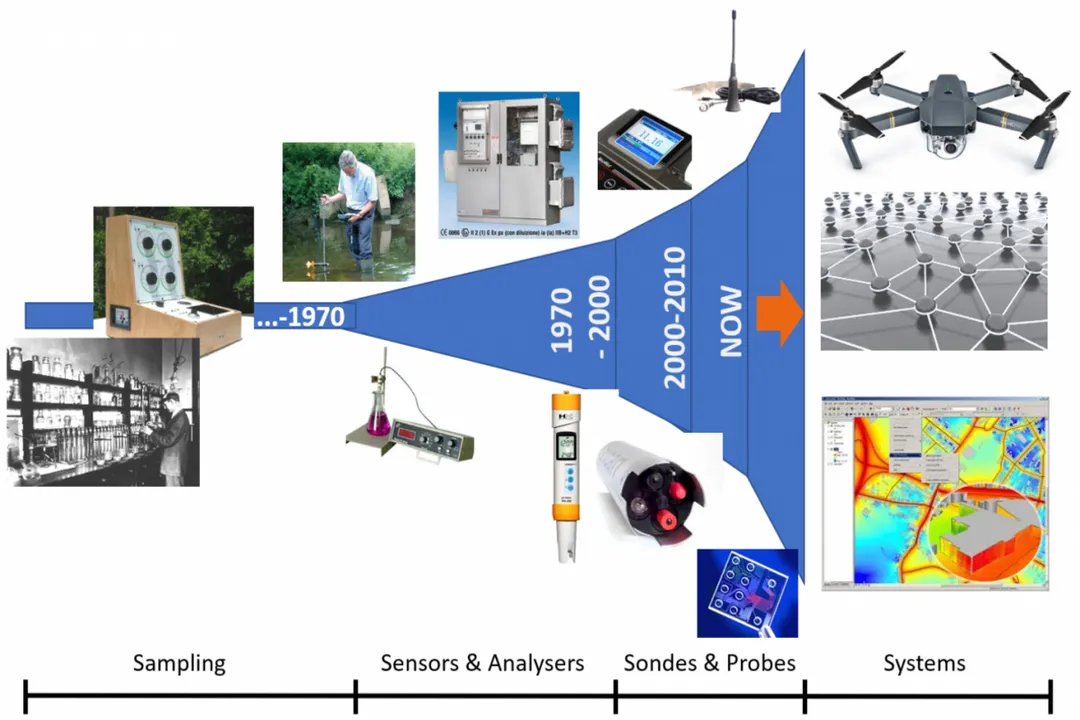
The evolution into modern monitoring involved a transition from these manual, often subjective observations to quantifiable, continuous measurement. For instance, monitoring for dissolved oxygen, which is vital for aquatic life, required specific titration methods for decades before electrochemical sensors became widely accessible. The development path shows a clear progression: from testing for known contaminants using wet chemistry to developing broad-spectrum electronic detectors capable of real-time analysis.
One key aspect of this evolution involved developing sensors that could operate in situ—in the environment itself—rather than requiring a technician to collect a sample and bring it back to a laboratory. This shift saves critical time, especially when dealing with rapidly changing or acutely toxic conditions. For example, while traditional water testing might involve collecting a sample and waiting for lab results, modern systems aim for instantaneous feedback. This difference in feedback latency is crucial; in industrial settings, a delay of even a few hours in detecting a leak can lead to significant environmental damage or worker exposure, whereas public health testing allows for a slightly longer turnaround.
# Air Sensing
The history of sensing contaminants in the atmosphere follows a parallel track, often spurred by the visible evidence of industrialization. Early air quality assessment focused on highly visible pollutants, such as smoke from coal combustion. As scientific understanding of atmospheric chemistry expanded, the focus broadened to include invisible, yet highly toxic, gases and particulate matter.
The development of dedicated air quality sensing apparatus accelerated as the dangers of specific compounds became better understood. This process involved creating instruments sensitive enough to detect minute concentrations of harmful substances that posed chronic health risks, moving far beyond simple visual observation.
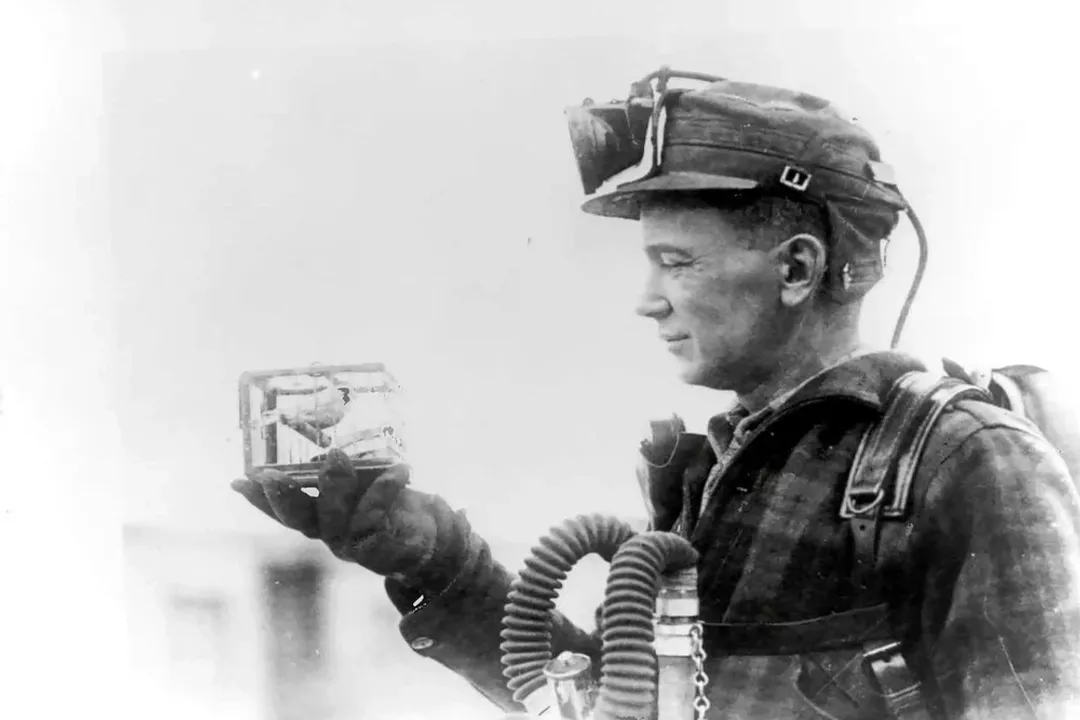
A tangible example of this applied technology came from the energy sector. In the early 1990s, a Phillips Petroleum engineer developed a unique pollution warning device designed to detect hazardous vapors. This device was an advancement because it integrated detection, alarm activation, and warning signals into one unit, providing immediate notice of potential danger in the workplace. While the specific underlying technology isn't detailed, the function—real-time, automated warning—marks a significant step in occupational and environmental safety monitoring.

# Detection Technology
Contamination monitoring relies on detecting the presence of matter or energy, leading to a diverse range of underlying scientific principles being employed across different media.
# Sensor Types
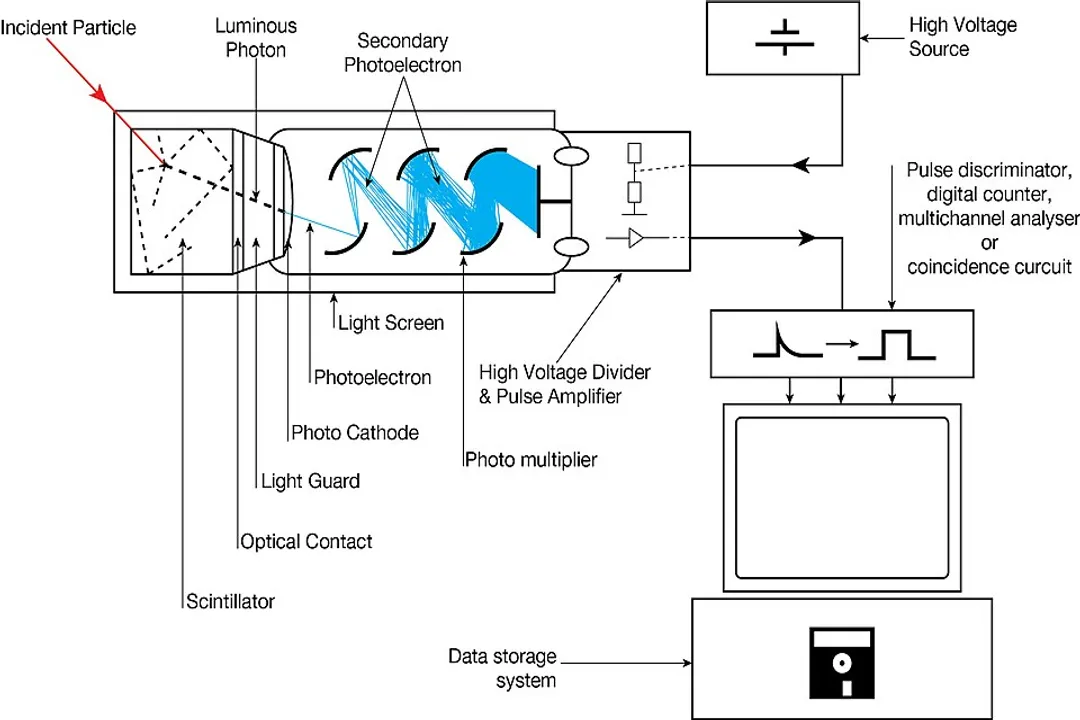
The instrumentation used spans from simple chemical reactions to complex physics principles. For example, the Scintillation counter represents a high-sensitivity detection method rooted in nuclear physics. This device functions by detecting high-energy radiation, such as X-rays or gamma rays, which cause a scintillator material to emit flashes of light proportional to the energy deposited. While often associated with radiation detection, the principle of using material response to energy input underpins many forms of advanced detection.
In contrast, modern water monitoring has seen developments in sensor arrays that can detect multiple chemical contaminants simultaneously in real time. Researchers at MIT, for instance, developed a sensor capable of distinguishing between different contaminants in water on the spot. This is a marked departure from older methods that often required isolating and measuring one analyte at a time.
| Monitoring Medium | Historical Approach | Key Technological Shift | Example Driver |
|---|---|---|---|
| Water | Visual inspection, chemical titration | Real-time, multi-contaminant electronic sensing | Public health, potable water safety |
| Air | Visual assessment of smoke/haze | Detection of invisible gases and fine particulates | Industrial emissions control |
| Specialized | Manual radiation counting | Automated particle counting and alarm systems | Worker safety, process control |
This comparative view highlights that invention in this area is often about integration—combining a physical or chemical principle with electronics to provide an immediate, actionable output.
# Particle Counting
Another specialized branch involves measuring particulate matter, critical for cleanroom environments, air quality, and process control. Particle Measuring Systems (PMS), for example, marked its 50th anniversary in the monitoring field, illustrating the long-term commitment required to perfect these measurement tools. These devices often rely on light scattering—shining a beam of light onto particles in a flow stream and measuring the resulting diffraction or scattering pattern to determine particle size and concentration. Patents in this field, such as the US patent US9040932B2, illustrate the ongoing refinement in how these instruments are built to be more accurate, reliable, or simply easier to operate.
# Regulatory Push
The broad adoption and standardization of contamination monitoring were heavily influenced by government action, particularly in the United States. The establishment of the Environmental Protection Agency (EPA) in December 1970 marked a formal institutional commitment to environmental protection. The creation of the EPA was a direct response to growing public awareness and scientific evidence showing the widespread impact of pollution.
This federal oversight meant that industries could no longer rely on minimal, self-regulated checks. The EPA’s mandate required measurable standards for discharges into air and water, which, in turn, demanded widespread, reliable monitoring methods. This regulatory framework created the market and the necessity for the engineering advancements seen in both industrial safety devices and public utility testing equipment. The very existence of standards like Maximum Contaminant Levels (MCLs) in drinking water necessitates the precision that engineers strive for in their sensors.
If we consider the context of the 1970s regulatory creation against the invention of the specific pollution alarm device in the early 1990s, we see a clear trend: initial regulation mandates measurement, and subsequent industrial innovation focuses on making that measurement safer and faster for operational personnel.

# Synthesis of Invention
The story of contamination monitoring invention is therefore a decentralized narrative. It involves the systematic documentation of water quality challenges dating back centuries, the targeted creation of devices like the Phillips vapor alarm for immediate workplace hazard mitigation, the leveraging of physics principles like scintillation for high-sensitivity tasks, and the cutting-edge development of micro-sensors that can handle complex chemical mixtures in real time.
What ties these disparate threads together is the concept of actionable data. A sensor that merely detects a contaminant without indicating its level, or one that works only in a lab, provides less value than a system that gives an immediate, quantitative warning. The ongoing work, as evidenced by recent academic research and patent filings, continues to push the boundaries of sensitivity, selectivity (the ability to measure one thing among many), and speed. The true 'inventor' of contamination monitoring is the convergence of public concern, regulatory necessity, and persistent scientific refinement across decades.
#Videos
Air Pollution Monitor | The Henry Ford's Innovation Nation - YouTube
Related Questions
#Citations
Phillips Engineer Invents Pollution Warning Device - The Oklahoman
A Brief History of Air Quality Sensing - TD Environmental Services
New sensor detects contaminants in water in real time | MIT News
Air Pollution Monitor | The Henry Ford's Innovation Nation - YouTube
PRESS RELEASE: Particle Measuring Systems Celebrates 50 Years
A Short history of Sensor Developments for Water Monitoring
A Brief History of Water Quality Control - Olympian Water Testing, LLC
Scintillation counter - Wikipedia
US9040932B2 - Surface contamination monitoring system and method
The Origins of EPA | US EPA