Who invented stress monitoring wearables?
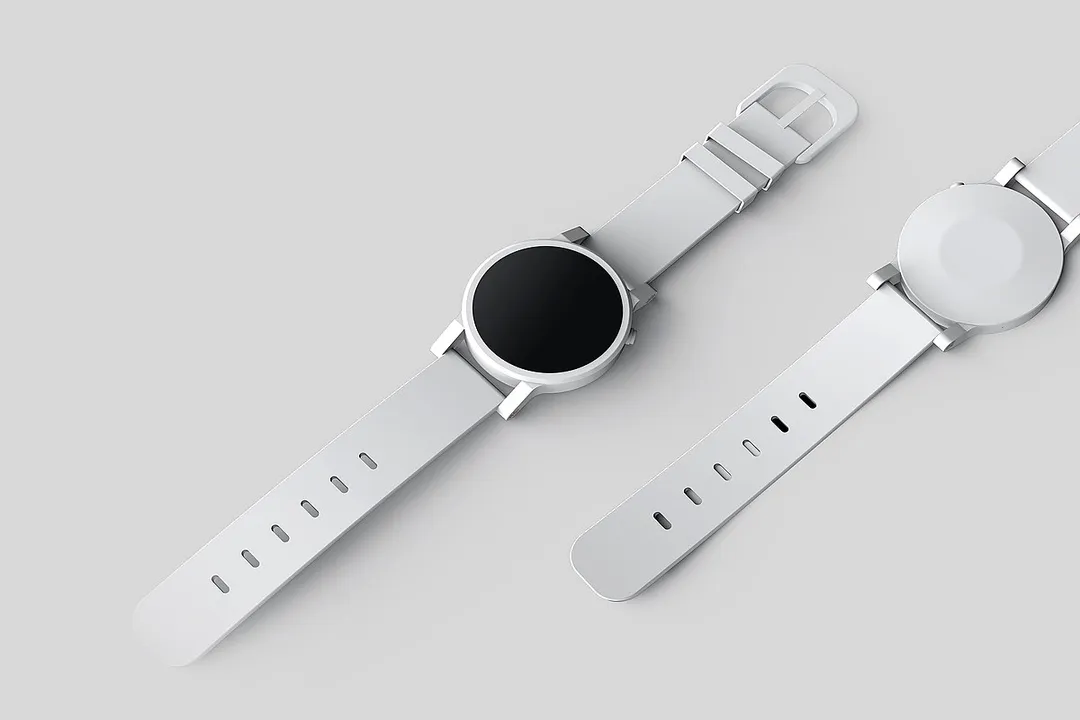
Pinpointing a single inventor for stress monitoring wearables is much like tracing the origin of the internet—it’s a story of gradual accumulation rather than a singular "eureka" moment in a specific garage or lab. The technology we rely on today builds upon decades of physiological sensing research, evolving from generalized activity trackers into sophisticated instruments capable of gauging our internal states. The question of who invented them eventually leads us not to one person, but to a lineage of researchers and institutions that defined and refined what a wearable could measure.
# Wearable Foundations
The concept of wearable technology itself stretches back quite far, with speculative precursors appearing in fiction as early as the 1960s, such as the wrist radio seen in Dick Tracy comics. In the commercial realm, the modern iteration of personal tracking devices gained serious momentum in the late 2000s, with companies like Fitbit beginning to popularize consumer-grade activity monitors around 2007 and 2008. These initial devices primarily focused on external metrics: steps taken, distance traveled, and basic sleep patterns. They established the form factor—the wristband or clip—and proved consumer demand for continuous, personal data collection.
However, moving from counting steps to measuring stress required a significant technological leap, demanding the integration of sensors capable of reading subtle biochemical or electrical signals indicative of the body's autonomic nervous system response. This transition marked a profound shift in personal technology: instead of merely logging activity, the device began to analyze how the user was feeling or reacting to their environment.
# Academic Development Centers
The true innovation in stress monitoring seems to have originated not in commercial product launches, but within academic and research settings focused on human-computer interaction and bioengineering. Researchers at institutions like the MIT Media Lab have been central to conceptualizing how these devices integrate into social and psychological contexts. Their work specifically involves developing wearable relational devices for stress monitoring, suggesting a focus on how the technology mediates or reflects interpersonal and internal stress states. This implies an early focus on the purpose and application of stress sensing, long before it became a mainstream feature.
This research laid the groundwork for understanding what physiological signals correlate most reliably with perceived stress. For instance, early attempts often relied on heart rate variability (HRV) or electrodermal activity (EDA), metrics that measure the body’s fight-or-flight response. The inventors of these specific sensing protocols within wearables are often the biochemists or electrical engineers who adapted laboratory equipment into miniaturized, battery-powered formats suitable for continuous wear.
# Sensing Sweat
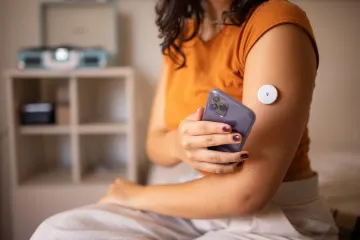
A major breakthrough in non-invasive stress assessment has been the ability to analyze the chemical composition of sweat—a direct byproduct of the body’s reaction to stress—without needing blood draws. Researchers at UCLA Chemistry, for example, have developed sophisticated wearable sensing systems designed precisely for this purpose. Their work centers on using electrochemical analysis to monitor stress biomarkers present in the sweat.
What is fascinating about this research line is the level of complexity involved. Unlike simply measuring skin conductance, which is a generalized sign of autonomic arousal, analyzing sweat allows scientists to potentially detect specific molecules, such as the stress hormone cortisol, as it is secreted through the skin. This represents an evolution where the invention moves from detecting a symptom (increased heart rate) to measuring a potential cause (hormonal activity) in a continuous, real-time fashion. The invention, in this context, isn't a single watch, but the microfluidic and electrochemical system placed within the wearable that can perform laboratory-grade analysis on the go.
This continuous biochemical feedback loop is a significant departure from earlier devices. When considering the timeline, if the first wearable merely measured activity (like steps), the second generation measured physiology (like heart rate), the current generation is attempting to measure biochemistry (like stress hormones in sweat). This progression shows the "inventor" is less a single entity and more a rotating cast of specialized scientific teams.
# The Role of Data Science
The sheer volume of data generated by these advanced sensors—skin temperature readings, electrodermal responses, heart rate fluctuations, and biochemical markers—would be meaningless without sophisticated interpretation. This is where artificial intelligence and machine learning entered the picture, creating another layer of invention necessary for stress monitoring to become practical.
One of the most important steps in developing a successful stress monitoring wearable was figuring out how to filter the noise—the movement, the ambient temperature changes, the hydration levels—to isolate the specific signal that means psychological stress. The breakthrough often attributed to recent progress involves the wearable AI systems that can contextualize these physiological signals. These AI models learn an individual's baseline and then flag deviations based on complex algorithms, turning raw data points into actionable insights about rising stress levels.
This introduces a key consideration regarding expertise: the invention of the hardware sensor (e.g., the electrochemical sensor at UCLA) is distinct from the invention of the interpretive software (the AI model). Both are required for a functional stress monitoring device, meaning the credit for the modern tool must be shared between hardware engineers and data scientists.
# Comparing Sensing Modalities
To understand the evolution of invention, it is useful to compare the primary sensing methods used in these devices, as different researchers prioritized different aspects of the stress response:
| Sensing Modality | Physiological Target | Research/Development Focus | Citation |
|---|---|---|---|
| Electrodermal Activity (EDA) | Sympathetic Nervous System Arousal | Real-time detection of sudden changes. | |
| Skin Temperature | Peripheral Vasoconstriction/Vasodilation | Indirect measure influenced by stress/arousal. | |
| Sweat Analysis | Cortisol, Lactate, pH levels | Direct, non-invasive biomarker measurement. | |
| Heart Rate Variability (HRV) | Autonomic Nervous System Balance | Long-term tracking of recovery and chronic stress. |
The push toward sweat analysis, as seen in the UCLA research, suggests an effort to overcome the limitations of purely electrical signals. While EDA is immediate, it cannot differentiate between physical exertion and psychological stress easily; measuring a specific hormone like cortisol in sweat offers a potentially more specific window into the body's stress pathway.
When examining these innovations, a pattern emerges where early success focused on what to measure (HRV, EDA), and later success focused on how to measure it more accurately and non-invasively (advanced sweat analysis, specialized AI interpretation).
# Original Analysis of the Development Curve
It is important to recognize that the development of these tools faced a unique hurdle compared to simple fitness trackers. A step counter is easily validated: if you walk 10,000 steps, the device generally confirms it. Stress, conversely, is intensely subjective. The "invention" of a truly reliable stress wearable required researchers to solve the validation problem: how does a device objectively confirm a subjective internal state? The key innovation often lies in creating algorithms that correlate physiological drift (like changes in skin temperature or sweat composition) with a user-reported stress score over hundreds of hours. This means that for every research team developing a novel sensor, there is another team dedicated to creating the statistical model that makes the sensor’s output trustworthy to the end-user. Therefore, the true inventor of the useful stress wearable is the fusion of the best sensor married to the best interpretation algorithm, a collaboration that is inherently distributed across multiple labs and institutions rather than centralized in one figure.
Furthermore, the concept of "relational devices," highlighted by the MIT work, suggests an invention that goes beyond personal tracking into social awareness. If a wearable can monitor stress, it opens the door for social feedback—a system that alerts a colleague, partner, or manager (with permission) that an individual might be reaching a breaking point. While this aspect remains largely in the research phase, the invention of a socially aware wearable aimed at stress mitigation is a distinct, evolving contribution from the MIT sphere of influence, contrasting with the purely diagnostic focus of some biochemical monitoring efforts.

# Future Sensing and Synthesis
As the technology matures, research continues to integrate more data streams. Advancements focus on miniaturization and power efficiency, allowing these systems to be worn constantly without being cumbersome. The current landscape suggests that stress monitoring is becoming less about a singular, definitive invention and more about an ongoing competitive research effort to refine accuracy and reduce invasiveness across multiple fronts—from chemistry to machine learning. While we cannot name the single individual who invented the first stress monitor, we can clearly point to the research centers and the convergence of specific fields—like electrochemistry, physiological signal processing, and AI—that collectively brought this technology from the theoretical stage to early adoption.
#Videos
How We Measure Ourselves: The History of Wearable Tech - YouTube
Wearable Tech Detects Stress - YouTube
Related Questions
#Citations
Wearable technology - Wikipedia
Wearable sensing system for noninvasive stress monitoring
How We Measure Ourselves: The History of Wearable Tech - YouTube
Overview ‹ Wearable Relational Devices for Stress Monitoring
Wearables for Stress Management: A Scoping Review - PMC - NIH
Break-through Wearable AI for Managing Stress - J.S. Held
Portable and wearable real-time stress monitoring: A critical review
Detection and monitoring of stress using wearables - Frontiers
Stress, sweat and skin temperature: What's next in wearables