Who invented a lock and key?

The genesis of the lock and key system is not attributable to a single person or moment in history; rather, it represents a slow, deliberate evolution of human ingenuity aimed at securing possessions and space. [3][5] The desire to restrict access predates written history, manifesting first as simple mechanical impediments before blossoming into the intricate devices we rely on today. [4] To pinpoint "the inventor" is impossible, as different cultures independently developed distinct methods of securing objects, each marking a significant step in personal and property protection. [1][4] The history is less about a single eureka moment and more about a series of necessary improvements responding to societal needs for privacy and asset control. [2]
# Earliest Evidence

The most concrete early evidence for a recognizable lock-and-key mechanism points toward ancient Egypt. [1][5] Around 4000 years ago, simple locks were in use there, though the design was primitive by later standards. [3][5] These early devices were primarily large, wooden structures used on doors. [1] The fundamental concept involved a bolt sliding into a keeper, with a mechanism to prevent the bolt from being retracted without the correct tool. [4]
The Egyptian version was a warded lock mechanism. [1] This system relied on a key that lifted or moved internal obstructions—the wards—so that the key could turn the lock mechanism, usually a rotating piece that slid the bolt. [3] The key itself was a heavy, oversized wooden tool featuring pegs or bits that corresponded precisely to the wards inside the lock casing. [1][5] Because these early locks were constructed from wood, they were inherently vulnerable to brute force, limiting their security value mostly to keeping out honest or casual intruders. [3]
Another significant early mention of securing devices comes from ancient China. [1] While precise dating can be complex, evidence suggests that locking mechanisms were also developed there independently, likely utilizing similar principles of internal obstruction. [4] Some sources suggest the Chinese were using complex metal locks featuring intricate internal designs as far back as 2000 BC. [1] These early Chinese innovations often focused on circular or padlock designs, showing a diversification of form alongside the mechanism. [1]
# Roman Refinements
The security technology took a major leap forward when the concept transitioned from wood to metal, a change often credited to the Roman Empire. [2][3] The Romans were masters of metallurgy, and they adapted this skill to lock-making, moving away from the bulky wooden creations of the Egyptians. [1][8] They developed metal padlocks that were smaller, more portable, and much more difficult to break compared to their wooden predecessors. [3][5]
The Roman contribution was refining the warded principle, making the internal wards smaller and more complex, which in turn allowed for smaller, more intricate keys. [1][2] While still relying on the principle of matching an obstruction, the precision required for the metal key to navigate the internal labyrinth was a significant step up in security. [3] This shift from wood to bronze and iron meant that security was no longer just about stopping an honest person; it was about resisting attempts at forced entry with simple tools. [5] It is worth noting that while the Romans perfected the metal warded lock, the fundamental idea of matching a key to an internal obstruction remained the core concept for centuries. [2]

# The Ward System
For millennia following the Roman era, the warded lock remained the dominant technology globally. [2][9] Its strength lay in its simplicity and reliability, making it suitable for everything from securing chests to main entrances. [3] A warded lock's security is entirely dependent on the pattern of the wards inside the lock case. [1] If the key cannot pass these barriers, the cylinder or bolt cannot turn. A duplicate key can be made simply by tracing the shape of the required internal cutouts, which is one reason why these locks offered relatively low security against determined entry. [1]
A fascinating aspect of the warded lock’s longevity is its accessibility. [9] Because the mechanism is straightforward—essentially just internal gates—it allowed for a broad application across various social strata. [2] Even as more sophisticated designs emerged in isolated areas, the warded lock persisted because it was cheap to manufacture and easy for a locksmith to repair or duplicate a key for. [3]
Consider the sheer duration of this technology's dominance: from ancient Egypt through the medieval period and well into the early modern era, the warded lock was the standard for property security. [9] This stability highlights an important aspect of technological adoption: sometimes, the good enough solution remains in place for centuries until a genuinely superior, and economically viable, alternative emerges. [2]
# Yale's Tumbler
The most significant evolution in locking technology since the ancient world—the shift away from the warded mechanism—is credited largely to an American innovator: Linus Yale Jr.. [6][7] While the concept of a pin-tumbler lock existed in some form prior to his work, it was Yale who perfected and successfully commercialized the design that forms the basis of most modern pin-and-tumbler locks. [6]
Before Yale, inventors like Bramah had developed more secure locks, notably a variation of the warded lock that used a key with cuts only on its edge, making duplication harder, but the fundamental principle of static internal barriers remained. [1] Yale’s breakthrough, achieved in the late 19th century, fundamentally changed how locks worked by introducing moving components that had to be aligned perfectly for the lock to operate. [7]
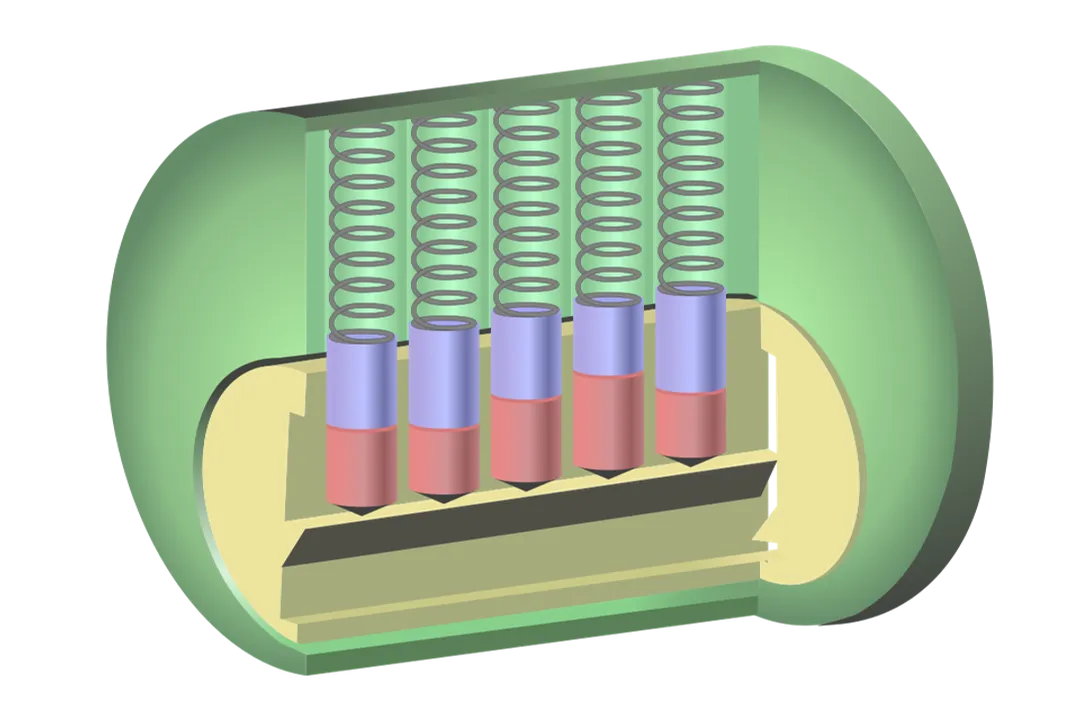
The pin-tumbler lock, patented by Yale around 1868, [6] uses a series of pin stacks, each consisting of two parts: a driver pin and a key pin. [7] These pins are spring-loaded and sit in drilled holes, blocking the rotation of the plug (the part the key enters). [7] The key's unique cuts lift the key pins to a specific height. When all the key pins are lifted to the exact right height—creating a straight line across the boundary between the key pins and the driver pins, known as the shear line—the plug can rotate freely. [6][7]
Linus Yale Jr. was building on the work of his father, Linus Yale Sr., who was already an established lock manufacturer. [6] The younger Yale’s lasting contribution wasn't just the invention itself but his skill in manufacturing and marketing these superior products, making high-security locks accessible for mass production. [6][7] The introduction of the standardized Yale cylinder, which allows the entire lock mechanism to be replaced simply by changing the cylinder rather than the entire door hardware, further cemented his lasting legacy in security. [6]

# Mechanism Comparison
To truly appreciate the shift caused by Yale, it helps to lay out the security hierarchy that developed over time. The core difference between an ancient lock and a modern one is the introduction of variable alignment versus fixed obstruction. [1]
| Lock Type | Primary Security Element | Key Feature | Security Level (Historical Context) |
|---|---|---|---|
| Ancient Warded | Fixed internal barriers (wards) | Key matches fixed pattern | Low; susceptible to lock-picking or impressioning [1] |
| Roman Warded | Metal wards | Smaller, precise metal key | Moderate; better resistance to simple prying |
| Pin-Tumbler | Movable pin stacks (driver and key pins) | Key lifts pins to a precise shear line | High; requires complex key shaping or manipulation [7] |
When comparing the earliest known locks to Yale's design, the difference is profound. An ancient Egyptian lock could potentially be opened by simply manipulating the bolt if the wooden construction failed, or by duplicating the key with rough carving. [3] A pin-tumbler lock, conversely, demands that the key precisely conforms to the height of every single pin stack simultaneously. [6] This added dimension of precision manufacturing and mechanical complexity made the pin-tumbler far superior for keeping out the average opportunistic thief. [7]
# Material Science Advance
The advancement in lock technology was inherently tied to the concurrent progress in material science and machining capabilities. [5] The ability to precisely cut and shape metal, as the Romans first demonstrated, made better warded locks possible. [3] However, the true leap required by the pin-tumbler design—the ability to drill precise, uniform holes for the pin stacks and manufacture keys with extremely tight tolerances—was only achievable with the industrial machinery of the 19th century. [6] This correlation suggests that security innovation often lags behind—or is driven by—the general capability of a society's manufacturing base. We can see this today; the development of high-security dimple keys or electronic locks is as much a testament to modern CNC milling and microelectronics as it is to the locksmith's design skill. [7]

# The Key Itself
While we often talk about the lock, the key is the critical counterpart, and its invention follows a similar evolutionary path. [4] The earliest keys were essentially fixed tools used to manipulate a bolt mechanism from the outside, not yet designed to fit inside the locking device itself. [3] The Egyptian wooden key, which was large enough to function as a handle to lift the internal wards, represents the first true key interface. [1]
The innovation moved from making the lock interior more complex (the wards) to making the key exterior more complex (the cuts). [2] When Yale introduced the pin-tumbler, the key evolved again. Instead of simply having bits that bypassed static wards, the key now had a specific pattern of valleys and peaks designed to align the internal moving parts perfectly. [7] This design also allows for much smaller keys, making them easier to carry, which solved a practical problem the large, unwieldy ancient keys presented. [5]
# Security Progression
Reflecting on this timeline, it becomes clear that security advancements often occur in response to recognized vulnerabilities. The vulnerability of a wooden lock was brute force; hence, the Roman response was stronger metal. [3] The vulnerability of the simple warded lock was lock picking, where one could "feel" the wards or use an impressioning technique to create a key. [1] The response to this was the pin-tumbler, which requires aligning multiple components simultaneously, making tactile feedback far less useful for picking. [6]
If we look at a common household lock today, the concept is almost always derived from Yale’s cylinder, but often enhanced with features like sidebars or restricted keyways to combat unauthorized duplication. [7] These modern additions are simply layers built upon the foundational pin-tumbler structure, demonstrating how the past informs the present. A homeowner today focused purely on physical security might research their local regulations concerning key duplication—a modern equivalent of worrying about a simple trace of an ancient wooden key—to ensure their chosen lock's key control features are respected by their local locksmith. [6] This shows that trust in the process of key creation is now as vital as the integrity of the mechanical device itself. [9]
The history of the lock and key is thus a narrative of escalating complexity, driven by the eternal tension between those who wish to secure things and those who wish to gain unauthorized entry. [4] There is no singular inventor, but rather a lineage of ingenious people—from the unnamed Egyptian carpenter to the skilled Roman metallurgist, and finally to Linus Yale Jr.—each solving the security problem as best as their era’s materials and tools allowed. [2][7]
Related Questions
#Citations
Lock and key - Wikipedia
A brief history of locks and keys - City Security Magazine
Who Invented Locks? - History of Locks
When and how did the concept of lock and key develop? - Reddit
Who invented the lock and key? - DSD Brands
Linus Yale - Lemelson-MIT Program
History of Locks - Vivint
A Brief History of Locks - From Catacombs to Modern Homes