Who invented the lock mechanism?

Tracing the origin of the lock mechanism is less about finding a single "Eureka!" moment and more about documenting a vast timeline of human necessity meeting mechanical ingenuity. It is a story stretching back millennia, moving from heavy wooden structures designed to secure grain stores to the intricate metal cylinders we rely on today. [1][9] The concept isn't tied to one inventor; rather, it’s a series of foundational inventions, with the most recognizable modern form being a refinement of much older principles. [3]
# Ancient Beginnings

The earliest discernible ancestors of the modern lock emerged in ancient civilizations, likely in the Nile Valley, perhaps as far back as 4,000 years ago. [1] These initial locking devices were massive affairs, constructed primarily of wood. [9] The foundational principle involved a large bolt sliding across the door, which was then secured by a separate locking mechanism—a large wooden pin or peg that dropped down to hold the bolt in place. [1] This wooden pin rested in corresponding holes in the bolt and the lock frame. [1]
To open such a device, a specially cut wooden key was required. This key had protrusions or wards that matched the configuration of the holes containing the securing pins. The key was inserted, lifted to the correct height, thereby raising the internal pins out of the bolt's path, allowing the bolt to be drawn back. [1][3] While effective for its time, these systems were bulky, required large keys, and were inherently limited by the strength of the wood. [9] The design relied on physical presence and relative complexity rather than true material strength.
# Metal Mechanisms

The evolution accelerated when inventors began transitioning from wood to metal, introducing greater durability and the possibility of smaller, more precise components. [1][5] The ancient Romans were instrumental in this shift, developing metal locks that were significantly more sophisticated than their wooden predecessors, often utilizing lever-tumbler mechanisms. [3] Roman locks were smaller and often portable, signifying a move from securing whole buildings to securing personal property or chests. [1]
The real challenge for early metal lockmakers was creating a mechanism that offered high security without requiring an enormous, unwieldy key. A major issue with early metal lever locks was that the key often needed to be almost as large as the lock itself to manipulate the internal levers effectively. [1] This limitation defined the next major breakthrough. A fascinating observation here is how the initial engineering focus shifted from securing a structure, as the Egyptians did with their large bolts, to personalizing security—the Romans needed a lock that could be carried, changing the entire scale and expectation of the device. [1][3]

# Bramah's Challenge
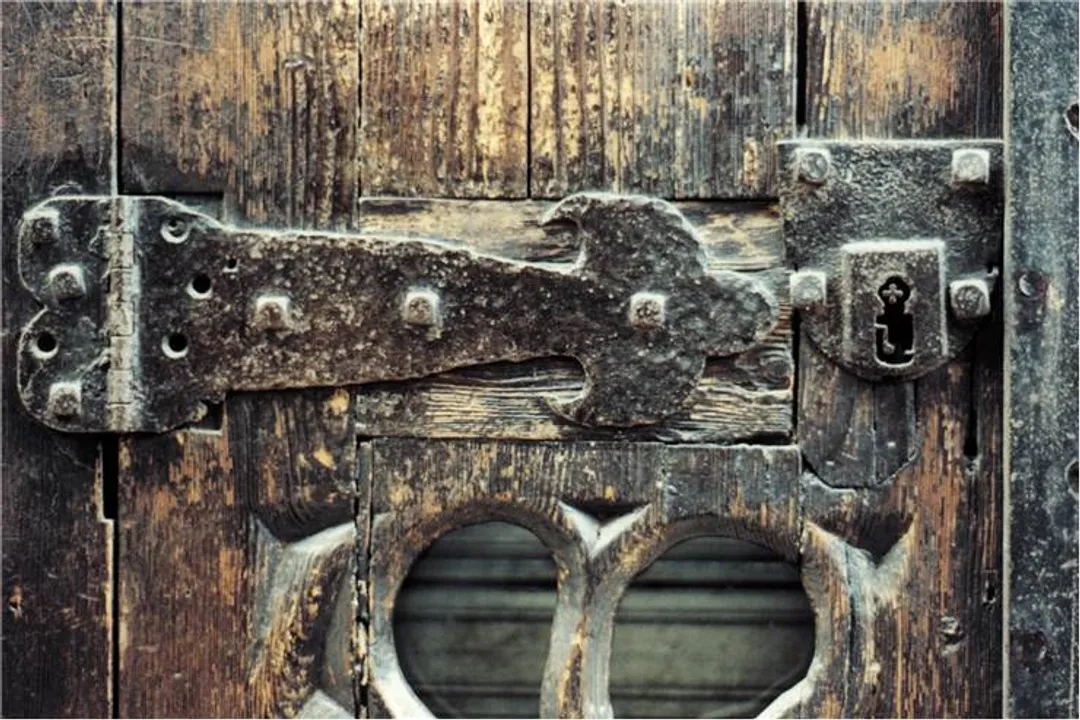
Centuries passed with steady incremental improvements, but the late 18th century brought a significant leap in anti-tampering engineering with the work of Joseph Bramah. [4] In 1784, Bramah invented and patented a lock that was considered virtually unpickable for decades. [4][6]
Bramah’s design moved away from the traditional pin-tumbler or simple lever systems and introduced a cylinder containing sliding gates. [4] The key for this lock was unique; it was a flat piece of metal with notches cut along its edge, designed to lift these internal gates to the precise required height. [4] What made it so difficult to defeat was that the key acted directly on the locking bolt via these gates, and the components were held under spring tension. [4] To pick it, one would have to determine the exact depth of several internal gates without being able to see them or easily manipulate them individually, all while keeping the tension correct. [4] This established a new benchmark for mechanical security based on precision machining rather than sheer bulk. [4]
# Yale Refinement
While Bramah’s lock was a marvel, the mechanism that would come to dominate the 20th and early 21st centuries was the modern pin-tumbler lock, perfected by Linus Yale Jr.. [7][2] Building upon the concepts developed by his father, Linus Yale Sr., the younger Yale patented his now-famous design in 1861. [7]
The Yale design represents a streamlined and highly adaptable version of the ancient Egyptian wooden lock concept, but executed with metal precision. [3][7] In this mechanism, a cylinder (the plug) rotates inside a housing. [5] The crucial elements are the series of vertical holes drilled through the housing and plug, each containing a driver pin resting on a smaller key pin. [3][7] When the correct key is inserted, its specific cuts lift the key pins to a precise height, aligning the tops of the key pins with the driver pins, creating a straight line, known as the shear line, between the plug and the housing. [3] Only when all pins are correctly aligned can the plug rotate to retract the bolt. [5]
Linus Yale Jr. was inducted into the National Inventors Hall of Fame for this contribution, cementing his place as the inventor of the lock mechanism that became the global standard for residential and commercial security for over a century. [2] The simplicity and scalability of the design—you could easily change the lock's security by simply changing the pin configuration—made it superior to many of the larger, less adaptable lever or warded locks that preceded it. [7]

# Schlage Convenience
Security is only one side of the coin; usability is the other. Even the best lock becomes a liability if it significantly slows down authorized entry. In the early 1900s, this balance was addressed by Walter Schlage. [8]
While Yale provided the core mechanical cylinder, Schlage is credited with patenting the first practical lock that could be opened with a key from either side of the door—a double-entry lock, around 1907 or 1908. [8] Before this innovation, many interior or deadbolt systems required turning a key, a knob, or a thumb-turn on the inside to unlock it. [8] If someone left a key hanging in the lock on the interior side, the exterior side remained inaccessible, regardless of whether one had an exterior key. [8] Schlage’s mechanism ensured that if one side was unlocked, the other side immediately followed suit, enhancing not only convenience but also safety during emergencies. [8]
# Evolutionary Context
It is vital to view the lock's history not as a series of isolated inventions but as a constant, back-and-forth arms race between the lockmaker and the would-be intruder. [9] Each advancement in security spurred new methods of bypassing, leading to the next iteration of mechanical defense. [1] The transition from the heavy, external protection of the ancient world to the internal, precision-based security of the modern era reflects a general trend in engineering: moving complexity from the macro scale (large wooden structures) to the micro scale (precisely cut metal pins). [3][5]
The modern mechanical lock, largely defined by the Yale pin-tumbler, is a testament to the fact that complex problems often find their most elegant solutions in the clever application of simple physical laws—in this case, alignment along a single shear line. [7] While new electronic and biometric systems are now common, the fundamental mechanical logic employed by Bramah and perfected by Yale remains the basis for countless physical barriers worldwide. [4][7]
Related Questions
#Citations
Who Invented Locks? - History of Locks
Linus Yale, Jr. - Door Lock - National Inventors Hall of Fame®
The 4,000 Year Old History of Locks - ThoughtCo
Bramah's Lock - Historic UK
The cylinder lock - Historical locks
The History of Locks - The Inventors
Linus Yale - Lemelson-MIT Program
Schlage Lock Lore | Lock, Door, Key History - Anderson Lock
Exploring the Evolution of Locking Mechanisms: From Ancient Times ...