Why was the safety bicycle safer than the penny-farthing?
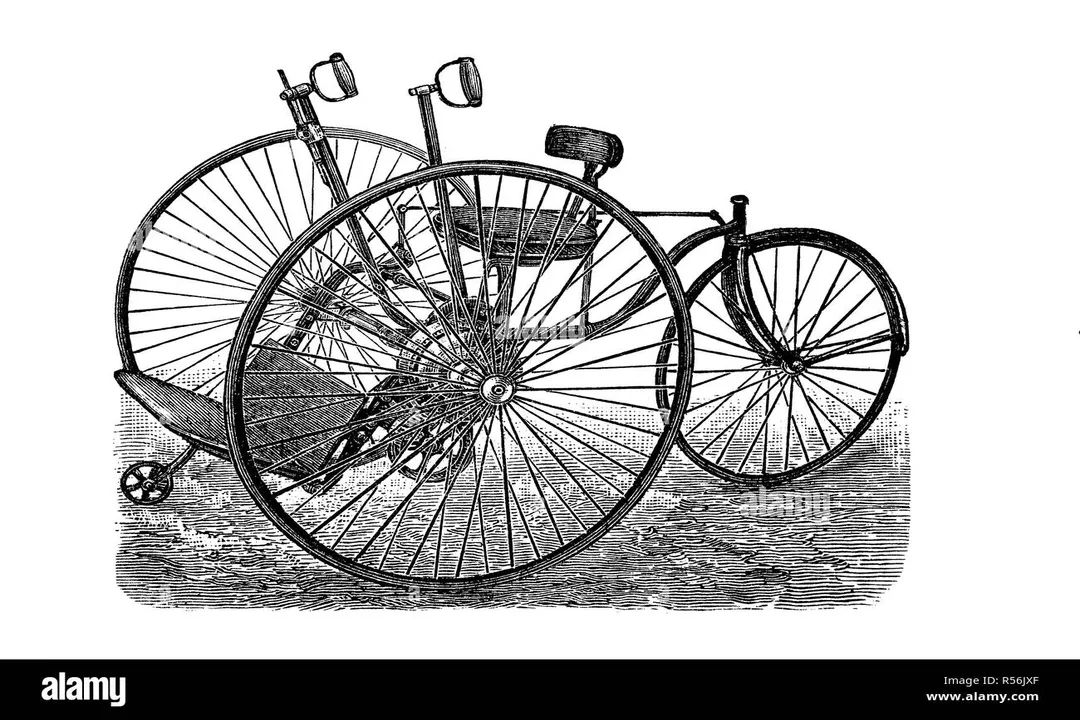
The Victorian era of personal transportation witnessed a truly peculiar machine dominating the roads: the high-wheeler, better known today as the penny-farthing. [1] Named for its visual resemblance to the large penny coin next to the smaller farthing coin, [3] this bicycle was a marvel of its time, capable of impressive speed thanks to its massive front wheel. [3] Yet, this speed came at a steep, often fatal, cost, making the transition to the safety bicycle one of the most critical leaps in cycling history. The fundamental difference in design between the two machines dictated their respective safety profiles, forever changing who could ride and how they traveled. [2]
# Speed Through Size
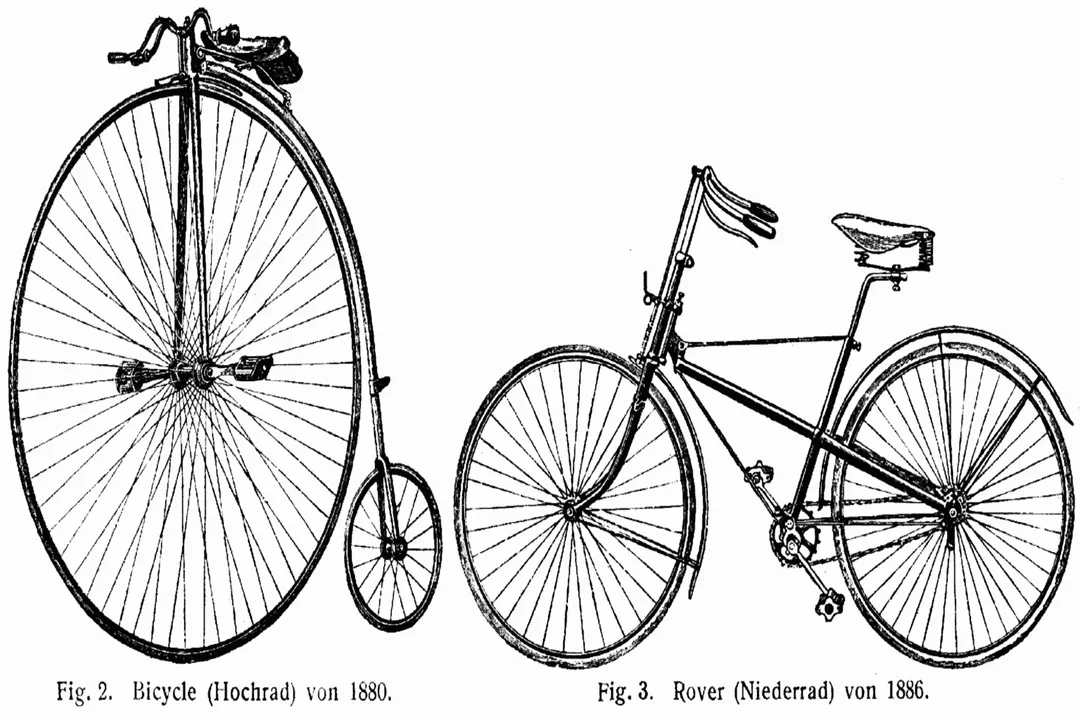
The driving philosophy behind the penny-farthing was wonderfully direct: to achieve greater distance with a single rotation of the pedals, one simply needed a larger wheel. [4] Since the pedals were fixed directly to the hub of the main wheel—a direct-drive system—the wheel’s circumference was the gearing. [3][4] Riders were, in essence, trying to maximize this circumference, limited only by the length of their own legs and their ability to mount the machine. [4] This necessity placed the rider perched precariously high, directly over the axle of the enormous front wheel. [1] While early versions featured iron or steel wheels, the later addition of solid rubber tires did smooth out some of the ride, offering a slight improvement over the punishing experience of earlier "boneshakers". [3]
# The Header Hazard
While the height offered a commanding view and impressive rolling distance, it also created a catastrophic failure mode: the infamous "header". [3] Because the rider’s weight was positioned so far forward and high above the center of gravity, any sudden obstruction or abrupt deceleration instantly converted the rider into a projectile. [3] Hitting a small bump, descending a steep grade, or braking too aggressively could pitch the rider headfirst into the ground. [3] Head injuries were so rampant that riders developed desperate countermeasures, such as propping their legs over the handlebars during downhills to ensure they might be thrown off feet-first instead. [4] Braking itself was a delicate affair; without modern braking systems, slowing down meant applying back pressure against the forward motion of the pedals, a technique that, if applied too forcefully, resulted in the bike pitching forward over its axle. [4] For a machine that required skilled mounting and dismounting—often involving a running start—the consequence of a simple miscalculation was severe. [1]
# The Chain Solution
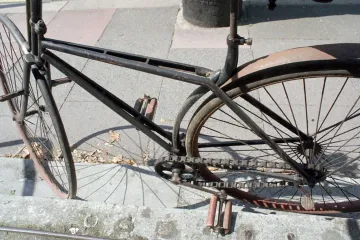
The arrival of the safety bicycle in the late 1880s marked the end of the high-wheeler's reign because it solved the core dilemma of speed versus safety through transmission. [1][2] The key innovation was the introduction of the chain drive, which transferred the power from the pedals (now positioned centrally) to the rear wheel. [2] This innovation decoupled the wheel size from the pedaling mechanism. Speed was no longer dictated by the diameter of the wheel required to cover distance in one revolution, but by the mechanical advantage provided by gearing—a system that modern bicycles still rely upon. [4] The safety bicycle featured two wheels of approximately equal size, which drastically lowered the seat height and, crucially, the center of gravity. [2]
The resulting design offered better balance and stability, making mounting, dismounting, and stopping far easier. [2] With the rider seated lower, their feet could easily reach the ground, providing a reliable means to stop without risking a forward pitch. [2] This fundamental change in structure meant the safety bicycle could achieve comparable speeds to the penny-farthing, but with vastly superior control and safety features. [3]
This shift from direct drive to chain transmission represents more than just a mechanical upgrade; it signals a change in engineering philosophy. The penny-farthing was an elegant, if terrifying, solution based on maximizing mechanical leverage through sheer scale. [4] The safety bicycle, however, embraced transmission—the ability to multiply force through a series of linked components. This principle of using gears and chains to manage speed and power is the foundation of nearly every complex machine developed since, from factory equipment to automobiles, demonstrating that the true innovation wasn't just equal wheels, but the system that connected the input to the output. [4]
# Social Utility Over Daring Prowess
The difference in riding experience also reflects a significant societal adjustment regarding the purpose of personal transport. In the days of the penny-farthing, riding required a high degree of specialized skill. For many early adopters, mastering such an awkward, high-perched machine was a spectacle and a status symbol—a feat of daring akin to the mastery required for horseback riding. [4] It catered to those who wished to display their physical prowess and bravery. [4]
The safety bicycle, by contrast, prioritized utility and accessibility. [2] Because it was easier to balance and stop, it was suddenly practical for everyday travel over longer distances, rather than just sport or novelty. [2] Perhaps the most profound social consequence was its immediate suitability for women. [2] Susan B. Anthony famously championed the safety bicycle, noting it did "more to emancipate women than anything else in the world" by granting a tangible feeling of freedom and self-reliance. [2] The safety bicycle was not designed to show off how brave one was, but how efficiently and safely one could move through the growing urban environment. The fact that the earliest successful safety models often included brakes as standard equipment, a feature sometimes missing from their predecessors, underscores this fundamental shift from an object of athletic display to a tool for everyday mobility. [1][2] The legacy is clear: the safer, more practical design is the one that survived to become the universal bicycle we recognize today. [2]
Related Questions
#Citations
Penny-Farthings: Transportational Death Traps
Why was the safety bicycle safer than the penny-farthing? Start your ...
Why the penny-farthing? - Bicycles Stack Exchange
TIL that head injuries were so common on Pennyfarthing bicycles ...
Was is (was?) a safety bicycle? - Straight Dope Message Board