Who created the Dustbin?
The story of the dustbin isn't a simple tale of one lone inventor in a workshop; rather, it’s a narrative woven from necessity, public health crises, and shifting urban regulations across centuries. Before standardized containers became the norm, waste disposal was often a chaotic affair, ranging from simple refuse pits to tossing rubbish directly into the streets or waterways. [6][9] Even in sophisticated ancient civilizations like Rome, while public latrines existed, the management of general household refuse often relied on basic, unsanitary methods. [9] For much of history, if a city provided a collection system at all, it involved householders placing their accumulated trash—often just ashes and general debris—in whatever container they possessed, such as wooden boxes or barrels, waiting for a cart to pass by. [6] This meant that even a rudimentary municipal service relied entirely on whatever vessels citizens could muster.
# Ancient Refuse

The problem of accumulating domestic waste is hardly new. Archaeological evidence suggests that sophisticated societies in the past wrestled with refuse management just as we do today. [9] In places like ancient Babylon, methods were developed to deal with the sheer volume of daily discards. [9] Similarly, the Roman world, renowned for its engineering feats, had established latrinae and drainage systems, showing an early recognition that public health was linked to waste removal. [9] However, these systems rarely addressed the individual household's role in containment prior to collection. The jump from an open dumping approach to a requirement for personal containment marks a significant social and regulatory shift, one that took place primarily in the densely populated cities of the 19th century. [6]
# Paris Prefect

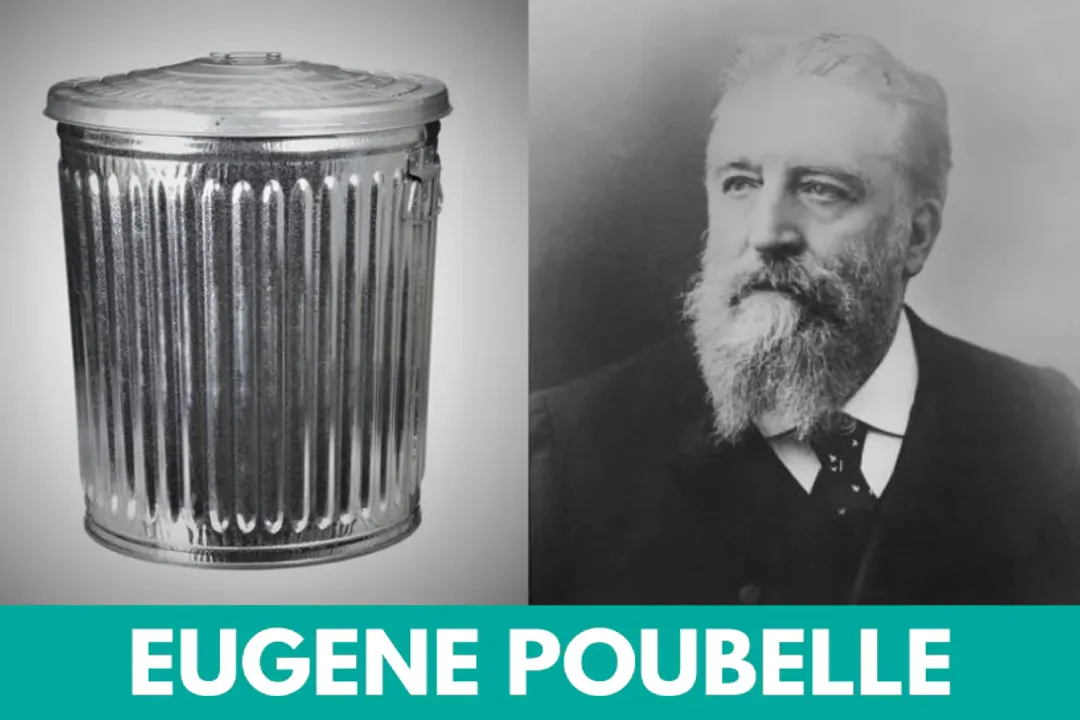
The individual most commonly credited with formalizing the concept of the household dustbin in a major European capital was Eugène Poubelle. [1][3] Poubelle was not an engineer or a garbage collector; he held the distinguished position of prefect of the Seine department, essentially governing Paris, in 1884. [1][3] His actions were driven by the pressing need to improve sanitation within the rapidly growing metropolis. [3] The sheer density of Parisian life made haphazard waste disposal a significant health hazard, necessitating a centralized, regulated system for how refuse left the home. [6]

# Lidded Ironware
Poubelle’s significant contribution was not the invention of a receptacle itself, but the mandate regarding what that receptacle had to be and how it had to be used. [1][3] In 1884, he issued regulations requiring that residents of Paris use specific containers for their garbage. [3] These mandated receptacles were explicitly described as lidded containers made of galvanized iron with fixed bottoms. [1][3] This specification was key; the lid addressed immediate pest and smell issues, and the sturdy, fixed-bottom design made them durable enough for repeated lifting and emptying by municipal services. [1] Contrast this strict, official specification with the 18th-century reliance on citizens using their own wooden barrels or boxes; Poubelle professionalized the interface between the home and the street cleaner. [6] This regulatory move represented a fundamental shift, prioritizing public cleanliness over individual convenience in the choice of container. [3]
# Container Naming
The direct impact of Poubelle’s legislation was so profound in Paris that the general term for a dustbin in the French language became poubelle. [1][3] This linguistic legacy is a powerful indicator of the authority and scope of his decree. [3] While the English term "dustbin" evolved from the collection of fine ash and dust, the French adopted the inventor's name for the device itself. [6] It is interesting to note that while Poubelle solved the problem for Paris with a specific metal design, the evolution of waste management shows that a government mandate for a fixed container eventually gave way to designs emphasizing mobility and user-friendliness for the homeowner, a conceptual leap driven less by municipal decree and more by consumer product development later on. [5]

# Wheeled Advance
The static, heavy, metal poubelle defined the standard for many decades, but waste collection technology did not stop in the 19th century. The next major revolution came not from a city official, but from an inventor focused on making the homeowner’s weekly chore easier: Robert Melbourne Munford. [5] In 1968, Munford developed the modern wheelie bin. [5] His innovation was integrating wheels and a hinged lid into a lightweight, plastic container. [5] This was a radical departure from Poubelle’s iron standard. Where Poubelle sought uniformity and durability for the collector, Munford sought ease of movement and handling for the user. The wheelie bin allowed residents to move heavy loads of refuse to the curb without physically lifting or dragging a heavy metal box, fundamentally changing the physical interaction with waste disposal. [5]
# Design Contrast
Comparing the Parisian mandate with the later wheelie bin reveals two different eras of civic engineering. Poubelle’s success was measured by mandated standardization and public health improvement via enforced containment. [1][3] The wheelie bin's success, particularly as it spread across the UK and US, was measured by consumer convenience and efficiency gains during curbside collection. [5]
| Feature | Eugène Poubelle’s Mandate (c. 1884) | Robert Melbourne Munford’s Bin (c. 1968) |
|---|---|---|
| Primary Material | Galvanized Iron | Plastic |
| Key Feature | Fixed bottom, Lidded | Wheels, Hinged Lid |
| Driver | Public Health Regulation | Consumer Convenience/Efficiency |
| Movement | Stationary until collected | Mobile by user |
It is worth considering that the shift to plastic in the mid-20th century, embodied by the wheelie bin, would have been impossible without the earlier regulatory groundwork laid by officials like Poubelle. The concept of "every home has a designated receptacle" had to be established first before the design of that receptacle could evolve from iron to durable, molded plastic. [1][5] The initial resistance to providing any standard likely paved the way for later, more complex designs to be adopted when the economic and logistical benefits became clear.
# Modern Context
The evolution continues today, moving beyond simple containment toward material separation and recycling streams. [7] While Eugène Poubelle ensured there was a fixed place for "garbage" in 1884, modern waste management requires multiple designated containers—one for landfill, one for recycling, perhaps one for compost—making the simple galvanized iron box an artifact of a less complex era of waste management. [7] The legacy of the dustbin, therefore, rests on two pillars: the early 19th-century recognition that household waste needed regulation for public safety, cemented by figures like Poubelle, and the later 20th-century innovation that prioritized mobility and ease of use, as seen in the wheelie bin. [5][6]
#Videos
Invention Of The Wheelie Bin 🗑️- When Were Wheeled ... - YouTube
Related Questions
#Citations
Eugène Poubelle - Wikipedia
Who Invented the Trash Can? | History of Trash Cans - PlasticMill
Dustbins are named after French recycling innovator
Invention Of The Wheelie Bin 🗑️- When Were Wheeled ... - YouTube
The History of the Wheelie Bin
The History Of The Trash Can (and All Its Dirty Secrets) - Medium
Bins and the history of waste relations - Lancaster University
The Evolution of Waste Bins - POWER Bear Designer Bins