Who is the founder of textiles?
The inquiry into the singular founder of textiles quickly dissolves into the vastness of human prehistory. There is no single person who can claim the title, much like no single person invented the concept of using tools. Instead, textiles represent one of humanity’s most enduring and fundamental crafts, a continuous line of innovation stretching back tens of thousands of years. The story of textiles isn't about one person, but about a slow, methodical evolution from simple necessity to complex industrial art.
# Ancient Beginnings
The earliest evidence suggesting human manipulation of fibers points to a time deep in the Stone Age, long before written records existed to immortalize an inventor's name. The earliest concrete proof we possess comes not from woven fabric itself, which decomposes easily, but from impressions left behind on hardened clay. In what is now the Czech Republic, archaeologists have found fired clay fragments bearing impressions of woven material that date back an astonishing $29,000$ to $25,000$ BCE. This indicates that our Paleolithic ancestors were already engaged in complex interlacing or knotting techniques.
This initial phase was driven purely by survival. Early humans, like Neanderthals, relied heavily on animal hides and furs for warmth and protection. The transition to something we might recognize as "textile" involved adapting available natural resources into more flexible coverings. While hides served the immediate purpose, the need for lighter, more adaptable materials spurred the development of processes to transform plant matter into usable strands.
# First Fibers
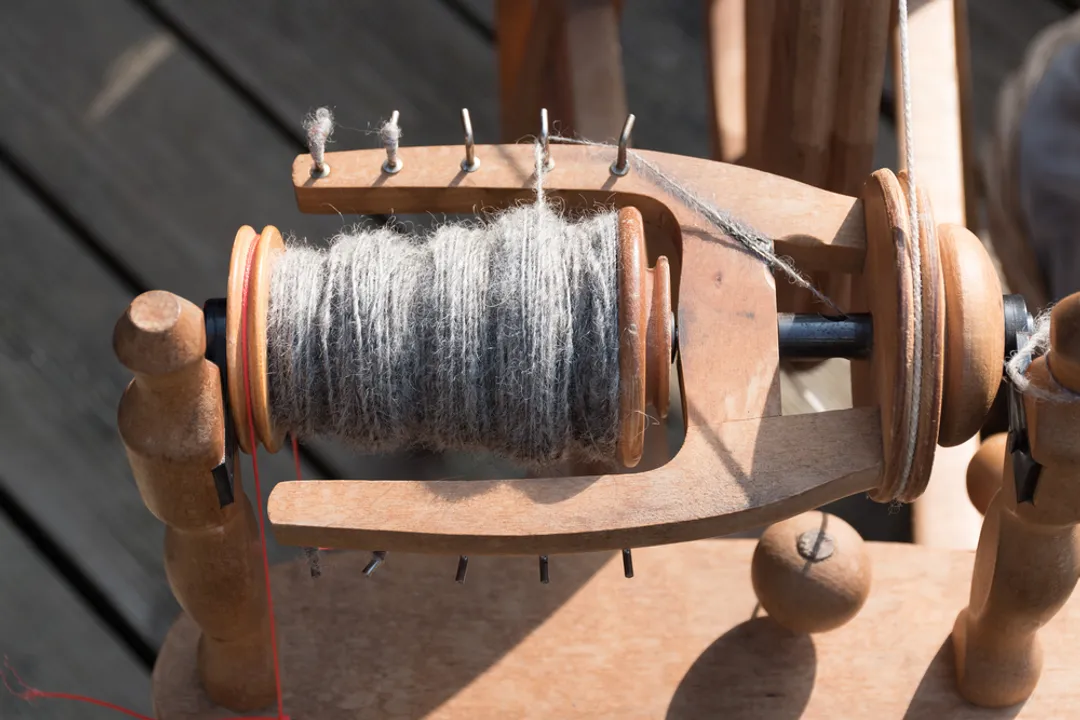
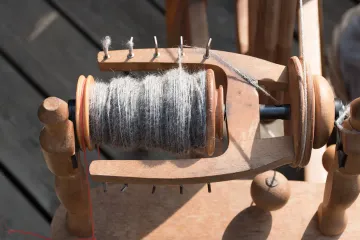
As early Homo sapiens, specifically Cro-Magnons, developed more sophisticated tool use, they began experimenting with plant-based materials. Imagine the painstaking effort required: gathering grasses, reeds, or the stalks of fibrous plants, separating the usable parts, and then twisting them together to create a continuous, strong thread. This process, known as spinning, is the true foundational technique of the textile world. Before spinning, materials were often used in their coarse, whole state or simply knotted.
The earliest fibers utilized would have been whatever was locally abundant. This included various grasses and reeds. Over time, societies learned to cultivate and process specific plants known for their durable fibers, most notably flax—the source of linen—and later, cotton. Simultaneously, animal fibers were refined. Wool, from domesticated sheep, offered superior warmth, and silk, harvested from silkworms, provided an unparalleled luxury fiber, though its cultivation was a closely guarded secret in ancient China for centuries. The mastery of processing these raw materials—be it retting flax stalks or drawing out wool into fine strands—represents the cumulative achievement of countless generations of anonymous craftspeople, not the singular breakthrough of one individual.
# The Loom's Arrival
The ability to create thread is only half the story; the ability to structure those threads into a durable sheet is the other critical development. This is where the invention of the loom enters the narrative. A loom is fundamentally a device that holds warp threads under tension, allowing the weft threads to be passed through and interlaced systematically. While simple hand-held frames or tablets could create basic plaits or braids, the development of effective, rigid looms allowed for the creation of wide, stable pieces of cloth necessary for clothing, blankets, and shelter coverings.
The transition from simple, perhaps upright, looms used for household production to more sophisticated, perhaps treadle-operated machines marked a significant step in efficiency, though the core mechanism of interlacing remained consistent for millennia. The true "founder" of textile manufacturing, if one must anthropomorphize the process, might be the anonymous individual who first figured out how to keep the vertical threads taut and separated so that a horizontal thread could pass neatly between them, perhaps using notched sticks or rudimentary frames.
# Industrial Shift
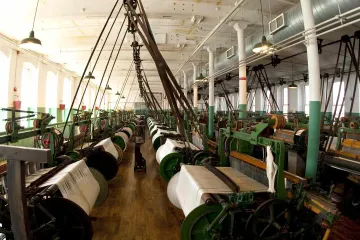
For thousands of years, textile production remained largely decentralized, a cottage industry where families spun yarn and wove cloth in their homes using hand-powered tools. This reality began to shatter in the mid-eighteenth century, particularly in Britain, marking the beginning of the Textile Revolution. This era saw the replacement of human and animal power with mechanical power, fundamentally changing society, labor, and global economics.
This industrial acceleration meant that while we still lack a single founder for textiles, we can definitively point to a roster of revolutionary inventors whose work collectively founded the modern textile industry. These individuals didn't invent weaving, but they invented ways to weave and spin hundreds of times faster than any human could manage by hand.
# Key Innovators
The core breakthroughs centered on mechanizing the two essential processes: spinning and weaving.
# Spinning Advancements
The initial bottleneck in pre-industrial textile production was the slow speed of producing yarn. Spinning by hand on a drop spindle or a simple spinning wheel was time-consuming.
- James Hargreaves addressed this in the $1760$s with the invention of the Spinning Jenny. This machine allowed one worker to operate multiple spindles simultaneously, dramatically increasing yarn output.
- Richard Arkwright followed with the Water Frame in $1769$. This machine used water power to drive rollers that drew and twisted the fibers, producing a much stronger thread suitable for warp yarns. Arkwright's machine was too large and expensive for home use, necessitating the creation of the first dedicated factories.
# Weaving Mechanics
Once yarn production skyrocketed, the weavers—using traditional handlooms—could not keep up with the supply of thread. This imbalance spurred the final major mechanical breakthrough.
- Edmund Cartwright patented the Power Loom in $1785$. This machine mechanized the process of weaving—passing the weft through the warp threads—using mechanical power, finally closing the loop on mass production.
These three inventors, alongside others who refined their designs, formed the vanguard of a technological movement that redefined what textiles meant—shifting them from an ancient craft to an industrial commodity.
| Inventor | Key Invention | Approximate Year | Primary Impact |
|---|---|---|---|
| James Hargreaves | Spinning Jenny | $1764$ | Increased number of spindles operated by one person |
| Richard Arkwright | Water Frame | $1769$ | Used water power; produced strong yarn; led to factory system |
| Edmund Cartwright | Power Loom | $1785$ | Mechanized the weaving process itself |
# American Factory
The industrial progress didn't stay confined to Britain. The technology was highly protected, yet its knowledge inevitably migrated. A critical figure in establishing the American textile industry as a separate entity was Samuel Slater. Slater, having worked in Arkwright's mills in Britain, memorized the machine designs and immigrated to the United States.
In $1790$, Slater recreated Arkwright’s water-powered cotton spinning technology in Pawtucket, Rhode Island, establishing the first successful water-powered cotton spinning mill in America. Because of this feat of technological transplant and industrial initiation, Slater is often honored as the "Father of the American Factory System". Like the British inventors, Slater is not the founder of textiles, but the founder of the mechanized factory system in a new geographic context.
# Defining the Founder
When evaluating who the "founder" of textiles is, we must acknowledge the inherent ambiguity of the term across historical eras. In the prehistoric sense, the founder is every ancient human who learned to twist fiber into a usable cord—a collective, anonymous entity spanning continents and millennia. In the context of modern textile science and commerce, the title is fragmented among inventors who solved mechanical problems related to speed and scale, such as Arkwright and Cartwright. The distinction lies between discovering the material (prehistory) and discovering the method of mass production (the Industrial Revolution). Examining these historical breakpoints reveals that the textile story is one of continuous, iterative invention, where one breakthrough opens the door for the next necessary innovation. For instance, the success of the Spinning Jenny immediately created a demand for faster looms, illustrating this chain reaction perfectly.
# Enduring Craft
Even with automated machinery and synthetic fibers dominating contemporary markets, understanding the foundational principles remains surprisingly relevant. If you ever find yourself needing to fashion a temporary repair outdoors, or even in an emergency scenario, knowing how to twist natural fibers to create a load-bearing cord—a skill perfected by those ancient textile makers—is invaluable. Furthermore, modern textile engineers studying material science often look back at the inherent properties of natural fibers like flax and wool to design better, more sustainable synthetics. Studying how ancient weavers managed uneven tensions or repaired breaks using simple tools offers an unparalleled lesson in problem-solving that high-tech software often overlooks. The tactile knowledge of fiber behavior, which existed long before any patent was ever filed, is the true, persistent heritage of this industry.
The history of textiles is, therefore, the history of human ingenuity itself—a record written in flax, wool, and cotton threads, showing us how we learned to clothe, shelter, and define ourselves across the ages.
#Videos
Textiles: Humanity's early tech boom | Virginia Postrel | Big Think
Related Questions
#Citations
Textile - Wikipedia
A Timeline of Textile History
A History of the Textile Revolution - ThoughtCo
A Look Back at the History of Textiles - Wilkins Linen
A Brief History of Textiles - Logo Knits
HISTORY OF TEXTILES: PART 3 - Revolution Fabrics
This week marks a milestone in the history of textiles ... | Hagley
A Journey Through Textile History: Ancient to Modern - Acme Mills
Textiles: Humanity's early tech boom | Virginia Postrel | Big Think
Textile Titans - Textiles History - NC State University