What did John Browning do?
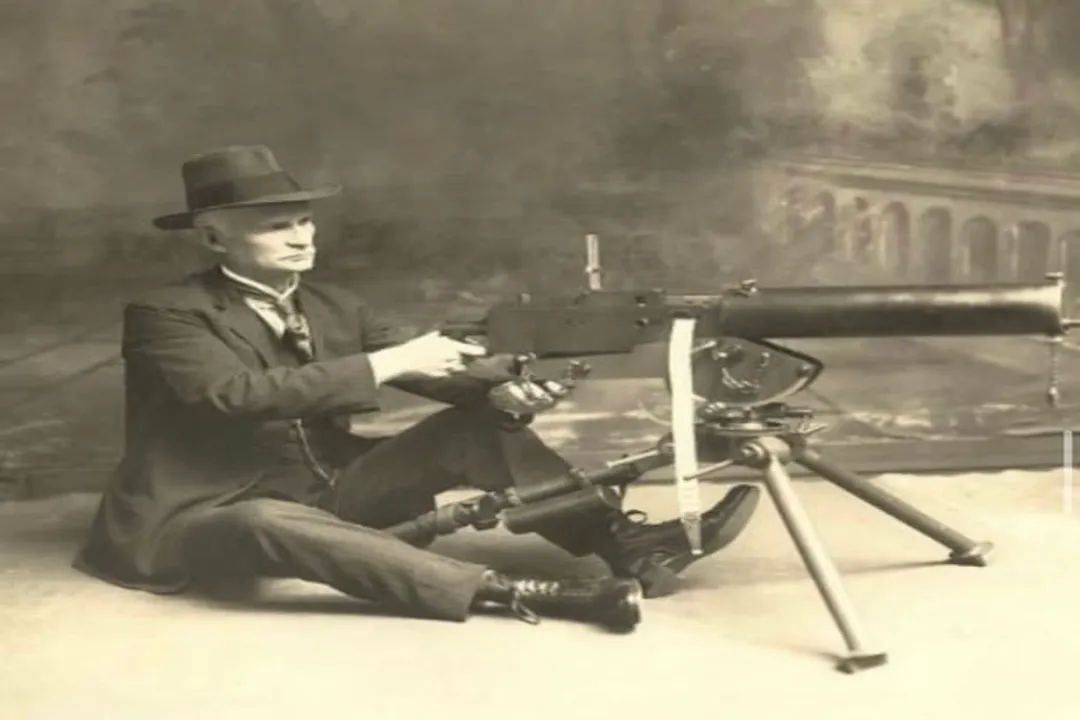
The name John Moses Browning stands as a colossal marker in the history of personal arms design, a figure whose inventive spirit fundamentally reshaped how firearms function, from sporting shotguns to the defining military sidearms of the 20th century. Born in Ogden, Utah, on January 23, 1855, [4][8] Browning entered a trade already familiar to him, as his father, William G. Browning, operated a gunsmith shop. [3][7] This apprenticeship in his father's workshop provided the practical foundation that would later allow him to transform mechanical theory into groundbreaking reality. [3]
# Early Foundation
The early environment in which John Browning grew up was one steeped in craftsmanship and the mechanical arts. Having a father who was a gunsmith meant that young John was exposed early to the intricacies of lock mechanisms, barrel making, and the repair of existing arms. [3][7] This hands-on experience cultivated an intuitive understanding of metal stress, tolerances, and practical application that few formally educated engineers of the era possessed. It is this grounding in the doing rather than just the theorizing that many suggest set him apart from his contemporaries. [2]
Browning’s formal education concluded relatively early, yet his curiosity and mechanical drive certainly did not. He began designing and patenting his own ideas while still a young man, moving quickly past simple repairs and modifications to wholly new concepts. [5][6] His first patent, secured in 1879, was for a breech-loading rifle modification, marking the official start of a prolific career that would span decades. [6][7]
# Patent Prolific
The sheer scale of Browning’s output is staggering, serving as tangible evidence of his relentless inventive mind. He secured more than four hundred U.S. patents across his lifetime. [1][3][5] To put that number into perspective, consider that many highly successful engineers might accrue a few dozen patents in a long career. Four hundred patents suggest not just a few successful ideas, but a continuous stream of mechanical problem-solving applied across multiple firearm platforms. [2]
This vast portfolio wasn't simply a collection of small tweaks. It represented fundamental breakthroughs in operating principles. He didn't just refine existing designs; he invented entirely new systems for weapon operation. These patents covered everything from the locking mechanisms in rifles to the gas-operated cycling in automatic weapons, cementing his reputation as the "Father of Modern Firearms". [3][4] It speaks volumes that many of the fundamental operating systems utilized in firearms today were first conceived or perfected in his workshops. [5]
# Winchester Partnership
Early in his career, the relationship between Browning and the Winchester Repeating Arms Company became highly significant. [1][5] This collaboration was mutually beneficial, as Winchester gained access to cutting-edge designs while Browning gained the manufacturing capability and market reach to distribute his inventions widely. [6] During this period, he developed numerous successful lever-action rifles and pump-action shotguns that significantly enhanced Winchester’s market position. [1][7]
However, the nature of this relationship soon evolved, signaling a shift in Browning’s long-term business strategy. When he conceived of a revolutionary new semi-automatic shotgun, Winchester, fearing cannibalization of their existing pump-action sales or perhaps simply unwilling to invest in the necessary manufacturing overhaul for a radically new system, declined to purchase the design. [5][9] This refusal proved to be a major inflection point, forcing Browning to look elsewhere for a partner capable of realizing his grander mechanical visions.
# European Designs
After parting ways with Winchester on the semi-auto shotgun concept, Browning took his designs to Belgium, specifically partnering with Fabrique Nationale d'Armes de Guerre (FN Herstal). [1][5] This move was arguably one of the most consequential strategic decisions in firearms history. FN embraced the new technology, leading to the introduction of the Browning Auto-5 shotgun. [1][5]
The Auto-5 was a landmark achievement because it successfully introduced reliable, long-recoil semi-automatic operation to the commercial market. [5][9] Unlike previous experimental designs, the Auto-5 worked consistently, providing hunters and sportsmen with a practical, faster-firing alternative to traditional repeating arms. [1] This success solidified the FN-Browning relationship, which would continue to produce iconic designs for decades, extending far beyond shotguns into pistols and other arms. [5][9] It is an interesting observation that had Winchester accepted the Auto-5 design, the subsequent history of FN Herstal—and perhaps the global landscape of firearm manufacturing partnerships—might look quite different today. [1]
# Military Icons
While his sporting arms brought him commercial success, it was his military designs that truly cemented his place in global history. Browning’s genius for creating reliable, high-rate-of-fire systems was heavily sought after by governments around the world. [5]
One of his most enduring military contributions is the M1911 pistol. This .45 caliber semi-automatic handgun became the standard sidearm for the U.S. military for over seven decades. [1] The M1911 is revered for its powerful cartridge and its simple, strong locking system, allowing it to handle the pressures of combat use effectively. [3] Even today, long after its official replacement, the M1911 platform enjoys massive popularity among civilian shooters due to its excellent feel and inherent reliability. [2]
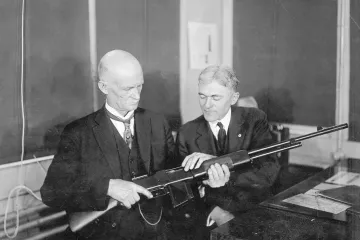
Equally important was his work on automatic weapons. He designed numerous machine guns that served the Allied forces, including recoil-operated and gas-operated systems. [5] Perhaps the most famous of these, and one that profoundly influenced infantry doctrine, was the Browning Automatic Rifle (BAR). [1] The BAR offered infantry squads a portable, light machine gun capability that could be carried and fired by one man, effectively bridging the gap between traditional rifles and heavy crew-served machine guns. [2] The military recognition of his work continued through World War I and World War II, with many of his designs remaining in service or influencing newer designs long after his passing. [1][5]
# Design Philosophy Comparison
Examining the spread of his inventions reveals a fascinating duality in Browning's approach. On one hand, the Auto-5 and later sporting designs focused on reducing recoil and increasing the rate of fire for the sportsman—a quest for comfort and speed in a competitive or sporting context. [1][9] On the other hand, his military work, exemplified by the M1911 and BAR, prioritized sheer durability and stopping power under extreme duress. [2][5] Yet, a common thread weaves through all these disparate products: an obsession with ensuring the mechanism cycled reliably, regardless of fouling or adverse conditions. [3] Where other designers might have settled for a mechanism that worked 90% of the time, Browning seemed intent on achieving 99.9% reliability, even if it meant a slightly more complex mechanism, such as the long-recoil system in the Auto-5. [6]
This dedication to function over pure simplicity for simplicity's sake is what truly separates his most famous creations. A lesser designer might have produced a simpler, less effective gun; Browning chose the most effective, robust system he could devise and then trusted his manufacturing partners to execute it perfectly. [2]
# Lasting Influence
John Moses Browning passed away in 1926, [5] but his impact on the industry remains undiminished. He essentially laid the groundwork for almost every modern semi-automatic firearm design that followed. [3] When we look at the vast array of modern pistols utilizing short-recoil principles or rifles using delayed blowback mechanisms, we are seeing descendants of his patented concepts. [1][5]
The legacy is not just technical; it is also commercial and historical. He transitioned from an independent inventor selling patents to a powerful design consultant with global reach. [6] The Browning Arms Company, founded to manage the family legacy and trademark, continues to thrive today, a testament to the enduring market appeal of the name. [7] His contributions mean that virtually anyone who handles a modern firearm, whether for sport, defense, or duty, is interacting with a technology born from the mind of this quiet Utah gunsmith. [2][4] It’s worth noting that while his military designs often dominated the headlines, the foundation of his business success arguably rested on the commercial viability of his sporting firearms—a rare blend of military-grade engineering applied successfully to the consumer market. [7][9] This dual success, moving seamlessly between the demands of the soldier and the expectations of the civilian hunter, is perhaps the most difficult feat in the history of arms design.
#Videos
The Many Miracles of John Moses Browning - YouTube
Related Questions
#Citations
John Browning - Wikipedia
Who is the most influential Gun designer? And why is it John ...
John Moses Browning: The Forgotten History of the Father of ...
John Moses Browning was born on this day in 1855. The “Father of ...
The Many Miracles of John Moses Browning - YouTube
John Moses Browning | Biography, Facts, & Gun Designs - Britannica
Browning Firearms Museum - The Legacy of John M. Browning
Historic Timeline - Browning
Gun designer John Browning is born | January 23, 1855 - History.com