Which country has the highest number of patents?

The global landscape of intellectual property is constantly shifting, but when looking for the country with the highest number of patents, the answer depends heavily on how you count them—whether you mean newly filed applications or the total number of patents currently being maintained. In recent years, however, one nation has decisively taken the lead in raw filing volume: China. [6] This powerhouse has become the most significant contributor to worldwide patent applications, far surpassing its nearest competitors. [6]
# Filing Volume Dominance
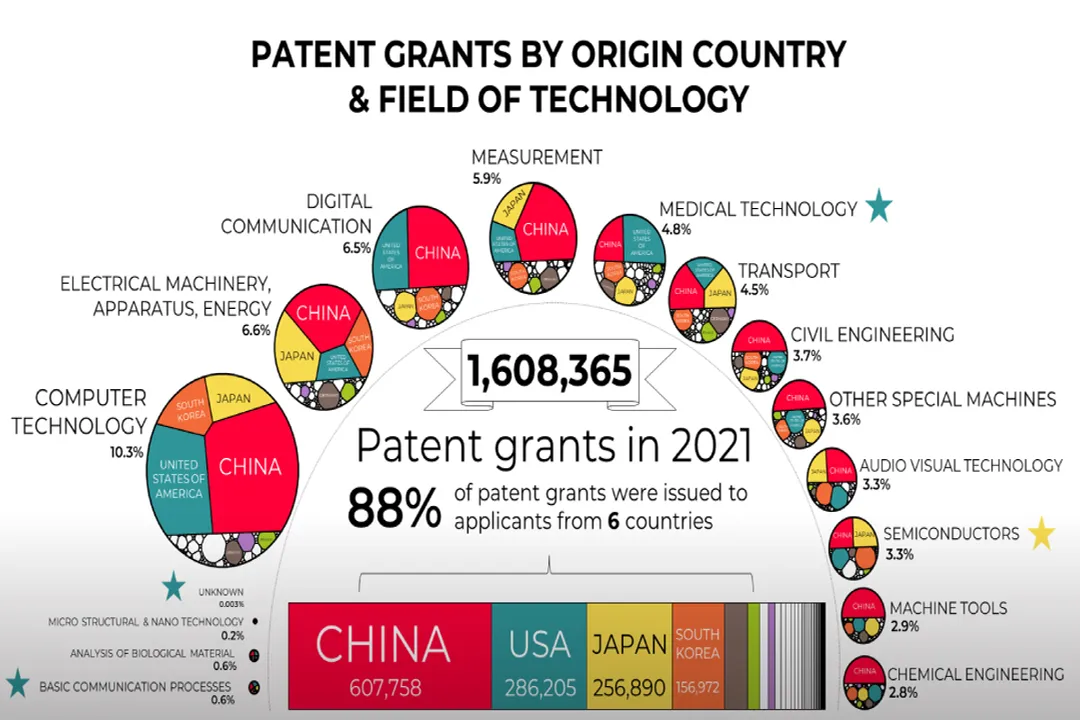
China's surge in intellectual property generation is not a subtle trend; it’s a massive shift in the global innovation landscape. [5][6] When examining the sheer quantity of patent applications submitted annually, China stands out substantially ahead of the rest of the world. [6] This volume reflects a national strategy emphasizing technological self-sufficiency and global competitiveness. [5] For context, the World Intellectual Property Organization (WIPO) tracks these figures closely, often reporting that China accounts for well over half of the world's total annual patent filings. [3][4]
To put this volume into perspective, consider the scale. In recent reports covering filing activity, the difference between China and the next country, frequently the United States, can be immense, sometimes by a margin of two or three times the number of applications filed. [1][5][6] This aggressive filing strategy is a crucial indicator of where the world's R&D focus is currently concentrated. [5] The World Population Review ranks countries based on patent data, and consistently places China at the top for filings, often followed by the U.S. and Japan. [1]
# Key Global Players
While China leads in recent application volume, a complete picture requires looking at the established intellectual property portfolios of other major economies. Several countries consistently rank highly in global patent activity, signaling their enduring roles as innovation hubs. [2]
The United States remains a titan in the IP world, not only through its own significant domestic filing rate but also because of the vast number of international applications filed by U.S. entities through systems like the Patent Cooperation Treaty (PCT). [5] U.S. entities have historically driven much of the global innovation landscape. [5] Similarly, Japan maintains a very strong position, reflecting decades of significant investment in research and development across its high-tech industries. [2]
Other major jurisdictions frequently appearing in the top tier of filers include the European Patent Office (EPO) as a regional block, South Korea, and Germany. [1][2] These regions and nations represent mature, diversified economies where innovation is deeply embedded in industrial sectors ranging from automotive to electronics and pharmaceuticals. [2] For instance, South Korea’s high ranking is often tied to leadership in memory chips and consumer electronics. [1]
Here is a snapshot illustrating the general hierarchy based on application volume in recent years:
| Rank | Country/Region | Primary Patenting Activity Area |
|---|---|---|
| 1 | China | Volume leader in new applications [6] |
| 2 | United States | High volume and global IP portfolio strength [5] |
| 3 | Japan | Strong historical and consistent filing levels [2] |
| 4 | South Korea | Significant activity in specific high-tech sectors [1] |
| 5 | European Patent Office | Major regional filing center [1] |
This comparison reveals that while volume is dominated by one nation, the quality and international reach of portfolios from the U.S. and Japan remain critical factors in the global IP balance. [5]
# Filing Versus Maintenance
A significant point of analysis when discussing "highest number of patents" is the distinction between applications filed and patents in force. A high number of filings, while indicative of research output, does not automatically equate to the largest active patent portfolio. [7]
A patent application requires significant investment to be filed, but keeping that patent active throughout its potential 20-year life span requires annual or periodic renewal fees. If a patent is not renewed, it expires and enters the public domain—it is no longer "in force". [7] Therefore, the country with the highest number of patents in force reflects the collective financial commitment and perceived long-term commercial value of its past inventions. [7]
When looking at patents in force, the rankings can look different, often showing more stable, established economies near the top. For example, one analysis of patents in force shows that the United States often leads or is very close to the top, followed by Japan and then China. [7] This difference arises because China’s massive surge in filing is relatively recent; many of those 2020s applications have not yet reached the stage where renewal decisions—which reflect commercial commitment—are being made over several years. [7] The U.S. and Japan have had decades to build up large, maintained troves of intellectual assets. [7]
An interesting point to consider for multinational corporations is the cost disparity. While China dominates in volume, the administrative and legal costs associated with maintaining a large portfolio across multiple jurisdictions—including the U.S. (USPTO) and Europe (EPO)—can be substantial. A strategy focused solely on filing quantity without a corresponding budget for maintenance in key commercial territories is essentially an investment in short-term statistics rather than long-term market protection.
This distinction highlights that a country leading in filings (China) is often different from the country leading in maintained assets (often the U.S. or Japan). [7]
# Technology Trends Shaping Rankings
The type of patent being filed also provides necessary nuance to the overall numbers. Certain countries dominate specific technological domains, which influences their overall ranking and global influence. [8]
One area seeing explosive growth is Artificial Intelligence (AI). [8] Patenting activity in AI is surging globally, and the distribution of these specific high-value patents is crucial for future technological leadership. [8] When examining AI patent applications, again, China frequently occupies the top spot, demonstrating a focused national effort to lead in next-generation technologies. [8] Following China, the United States generally holds the second position in AI-related filings, underscoring the intense global race in this field. [8]
The sheer volume of Chinese filings often comes from a broad base, but specialized reports on areas like AI, clean energy, or 5G show a strategic focus that underpins their overall high numbers. [6][8] Conversely, the U.S. portfolio might show a higher concentration of patents in software and biotech, reflecting the strengths of its dominant industries. [5]

# Global Competitors and Growth Rates
While China’s absolute numbers are staggering, observing the growth rate of patent filings across nations reveals where future challenges to the status quo are emerging. Reports tracking global innovation often compare the recent output of established leaders against rapidly ascending nations. [5]
In some periods, analysts have noted that while the US has historically outpaced other nations, competitors have been catching up, especially in the rate of patent generation. [5] This growth is not uniform; it is often concentrated in specific regions or spurred by targeted government or private sector investment. [5] For example, the NSF Science and Engineering Indicators often track these comparative growth speeds to gauge shifts in the global technological balance of power. [5]
If we look at the total number of patents granted by the top offices worldwide—which includes filings from entities worldwide—we see a clear pattern of concentration among a few large economies. [4] The U.S., China, Japan, South Korea, and the EPO member states collectively account for the vast majority of global patent grants. [4] This concentration suggests that while many countries file patents, the resources required for successful granting and commercialization remain centralized among the world's largest economic blocs. [4]
# An Editor’s View on Innovation Strategy
Understanding why a country files patents is as important as knowing how many they file. For a technology firm looking to compete internationally, relying solely on filings in one's home country is increasingly insufficient. The data strongly suggests that a successful global IP strategy must include a significant presence in the Chinese patent office (CNIPA) due to market size and the sheer volume of technological development occurring there. [6] However, a firm must also ensure robust protection in jurisdictions where patents are most likely to be upheld and enforced over the long term—areas where the U.S. and Japan traditionally hold stronger, older portfolios. [7]
This leads to a pragmatic consideration: filing strategically rather than maximizing raw numbers. For instance, a medium-sized European company might find it more effective to file fewer, high-quality patents in the USPTO, EPO, and CNIPA, rather than filing lower-quality, broad applications across ten smaller patent offices simply to boost a year-end filing statistic. The maintenance cost analysis mentioned earlier becomes a critical filter here; if a patent isn't worth renewing five years in, it might not have been worth filing in the first place. [7]

# Conclusion on Leading Nations
To circle back to the initial query: which country has the highest number of patents?
For annual new applications, the answer is definitively China, often by a very wide margin, reflecting its massive domestic manufacturing base and strategic focus on technological advancement. [6]
For total patents currently in force (the maintained portfolio), the answer is often the United States or Japan, reflecting their long history of sustained investment and commercial validation of intellectual property assets. [7]
Both metrics are vital, but the explosion of Chinese filings in the last decade marks the most significant recent change in the world's IP hierarchy, signaling a major rebalancing of technological output across the globe. [5][6] The competition today is less about who can invent, and more about who registers the most, and who maintains the most valuable assets for the decades to come. [7] The data from WIPO and national patent offices worldwide confirms this era of intense, multi-polar innovation competition. [3][4]
Related Questions
#Citations
Patents by Country 2025 - World Population Review
Top 10 Countries With the Most Patents Filed - PatentRenewal.com
patent applications - IP Facts and Figures
World Intellectual Property Indicators - Wikipedia
Global competitors outpace U.S. in patents - NSF
China is the largest contributor to global patent applications ...
Ranking of the 20 countries with the most patents in force - Statista
AI Patents by Country Revealed: The Top 15 Nations Dominating ...
2025 Global Trends & Insights - IFI Claims
Which Countries are Granted the Most New Patents?