revolution articles
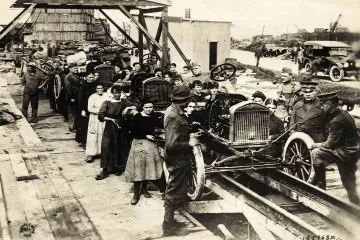
What crucial innovation did James Watt introduce to the steam engine to make it widely versatile and economically viable?
What was the primary application for Thomas Newcomen's early atmospheric steam engine?
What major organizational shift did Richard Arkwright’s *water frame* necessitate?
What limitation characterized the yarn produced by James Hargreaves’ *spinning jenny*?
Which contribution by Eli Whitney is cited as the blueprint for replication at scale, foundational for future industrial revolutions?
How did the efficiency gains from James Watt's improved steam engine primarily change the geographic requirements for industry?
Which figure is primarily credited as the 'Father of Railways' for successfully applying steam power to mobility?
Richard Arkwright’s *water frame* produced thread strong enough to be used for what specific part of woven fabric?
What concept, championed by Eli Whitney, transitioned manufacturing from artisanal unit-by-unit creation to standardized mass production?
According to the text's final assessment, why is James Watt's invention considered the single most important catalyst for the subsequent century of growth?
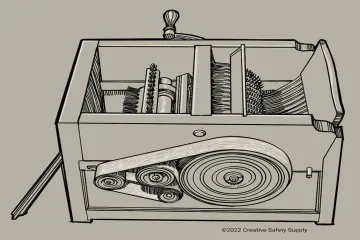
What concept represented Eli Whitney’s true contribution to the manufacturing revolution?
How did the idea of interchangeable parts fundamentally break from centuries of artisanal production?
What was the approximate daily output of cotton cleaning achieved by one worker using the cotton gin?
What specific government contract allowed Whitney to fully test his manufacturing theory regarding uniformity?
Why was the U.S. government primarily interested in Whitney's methodology for producing muskets?
What essential tools did Whitney need to invent to guarantee part uniformity during musket production?
What did Whitney's system change a repair job from, especially for military equipment?
What was the foundational division of labor unlocked by precision manufacturing under Whitney's system?
What is Whitney’s manufacturing philosophy sometimes referred to as?
Which industries adopted Whitney's standardized methodology after its success with muskets?