Did Lonnie Johnson sell Super Soaker?

The narrative surrounding the Super Soaker is often simplified into a question of a single transaction: Did Lonnie Johnson sell his iconic invention? The reality is far more nuanced, revolving around a calculated decision to license his intellectual property rather than sell the patent outright, a distinction that defined his decades-long financial relationship with the toy’s manufacturers. Lonnie Johnson, the engineering mind behind the pressurized water gun, remains the inventor and patent holder, operating under a licensing agreement that ultimately secured him substantial—though sometimes contested—royalties.
# Accidental Inspiration
The genesis of the Super Soaker was a classic tale of serendipity colliding with scientific expertise. Johnson, a nuclear engineer by trade, was working at the Jet Propulsion Laboratory (JPL) on the Galileo mission to Jupiter when the idea struck him in 1982. He was attempting to devise a heat pump that utilized pressurized water vapor instead of environmentally unfriendly freon. While working in his basement bathroom, an accidental leak shot a powerful, focused stream of water across the room. This unexpected jet of fluid immediately sparked an idea for a superior water toy. Johnson, who had a lifelong passion for tinkering—even once taking apart his sister’s baby doll to see how its eyes closed—spent his free time developing the concept. Working by day on projects like the Air Force's B-52 stealth bomber, he tinkered in his personal hours.
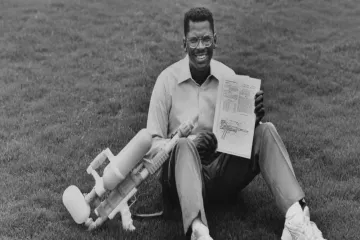
His initial prototype, crafted from PVC pipes, plexiglass, and a repurposed two-liter soda bottle for the reservoir, was tested by his seven-year-old daughter, Aneka, who reportedly "super-soaked every other kid on the Air Force base". This success validated the toy's potential beyond a mere basement experiment. Johnson secured the protection for his design when the U.S. Patent Office granted him a patent for his "Squirt Gun" on May 27, 1986. Having this patent was critical, as it meant he could prevent others from immediately capitalizing on his work without his consent.
# Licensing Over Selling
To bring the powerful design to market, Johnson knew he needed a production partner, as manufacturing the initial run himself was deemed too costly—one estimate placed the cost for the first thousand units at $200,000. Rather than selling the patent for a one-time fee, which many inventors do for immediate capital, Johnson opted to license the technology.
This pivotal business decision led him to the Larami Corporation, a Philadelphia-based toy company, whom he successfully pitched an improved prototype to in 1989. Larami manufactured the gun, which first appeared in stores in 1990 under the name “Power Drencher”. The product was a significant hit, selling two million units in 1991 after being rebranded as the “Super Soaker®”. This licensing arrangement meant Johnson received royalty payments based on sales, providing an ongoing revenue stream rather than a single buyout check.
The next major shift occurred in the corporate structure when Hasbro purchased Larami in February 1995. Although Larami continued to produce the Super Soaker brand products for a time, eventually closing in 2002, the ownership of the manufacturing arm—and the overall brand—transferred to Hasbro. Johnson’s agreement was with the licensee, meaning that when Hasbro acquired Larami, the terms of his licensing deal generally carried over to the new parent company.
It is important to understand this structure: Johnson did not sell the Super Soaker invention (the patents); he licensed it, and the company manufacturing it was sold to Hasbro. This licensing model, while providing immense wealth, also introduced the potential for complex accounting disputes down the road, as the value of the royalties depends entirely on the sales figures reported by the licensee.

# The Royalty Reckoning
The success of the Super Soaker was staggering. By 1991, it generated 1 billion in total sales**. This financial behemoth led Johnson to found his own company, Johnson Research and Development Co., Inc., in 1991. He also applied the underlying pressurized air technology to create variations for the Nerf Blaster line, securing further income streams.
Despite the initial licensing success, the relationship with Hasbro became strained. In 2013, Johnson took legal action against Hasbro, alleging that he was being underpaid royalties for the Super Soaker and several Nerf products covering the period from 2007 to 2012. This lawsuit was not a claim that he had never been paid—sources indicate he had been receiving royalties since the early 1990s—but rather a dispute over the accuracy of the payments received.
In November 2013, Johnson prevailed in arbitration, resulting in an award of nearly **73 million was compensation for underpayments during those specific years, meaning it was additional money on top of the royalties he had already been receiving, potentially implying his total lifetime earnings from the toy were much higher, perhaps even in the hundreds of millions. This outcome underscores the practical power of holding the foundational patent; even after the manufacturing entity was sold, Johnson retained the necessary leverage to enforce the original terms of his agreement.
If we compare the typical outcome for an inventor who sells a patent for a fixed sum versus one who licenses it for royalties, the contrast is clear. A lump-sum sale on a toy that nets over a billion dollars in sales might have netted Johnson a fraction of that total sum upfront. By licensing, he tied his fate to the product's continued success, which, while requiring vigilance, resulted in a far greater financial reward over time. This is a prime example of why securing and defending intellectual property rights is essential for creators, as the enforcement mechanism (the patent) is what kept the royalty stream flowing, even when the corporate structure changed hands.
# Beyond the Water Gun
To put the $73 million arbitration into perspective, it is crucial to recognize that Lonnie Johnson is far more than just the "Super Soaker guy." He is a highly accomplished aerospace engineer with an astonishing portfolio of innovation. Johnson holds over 250 U.S. patents across diverse fields. His work at NASA’s JPL involved complex projects like the Galileo mission to Jupiter and the Mars Observer. He has continued to focus on serious, world-impacting technology, including developing systems to convert waste heat into electricity (JTEC) and working on advanced solid-state battery technology.
When considering his substantial scientific career, one can surmise that the Super Soaker was developed with a practical financial goal: to generate seed money to pursue his more ambitious, energy-focused research. This context further illustrates why a dispute over royalties, even when already wealthy, was important—the funds were intended to support his ongoing scientific ventures, not just personal wealth accumulation. For instance, he has since funneled energy into his Johnson STEM Activity Center, aimed at introducing students from underserved communities to science and engineering fields.
The fact that Johnson was able to successfully litigate against a toy giant like Hasbro highlights a key element of his success: his deep technical expertise. A skilled engineer understands contracts, mechanisms, and systems, which likely aided him in articulating exactly where the accounting or contractual obligations of the royalty structure were being breached.
The question, "Did Lonnie Johnson sell the Super Soaker?" resolves to this: No, he retained ownership of the invention's core protection, the patent, by choosing to license it instead of selling it. This licensing model provided him with an enduring stream of income, which he successfully defended in arbitration, demonstrating that in the world of invention, the ongoing relationship with the product is often more lucrative and impactful than a single, initial sale.
# Protecting the Stream
The legacy of the Super Soaker is intrinsically linked to Johnson's commitment to IP protection. While the initial patent in 1986 provided a foundation, the ongoing battle with Hasbro over underpayment reveals the necessity of active stewardship over one's creations. It is a common scenario in licensing agreements where the volume and complexity of sales make accurate royalty calculations difficult or, perhaps, tempt the licensee to calculate to their own advantage. Johnson’s ability to secure that $73 million payment after years of being underpaid serves as a powerful case study. For any aspiring inventor developing a product now—whether it is a high-tech battery or a novel kitchen gadget—the lesson is twofold: first, secure a robust patent, and second, be prepared for the long-haul enforcement required to realize the full value of your creation. The best toy ever made for summer fun was secured not just by a burst of inspiration in a bathroom, but by decades of perseverance in the laboratory and the boardroom.
Related Questions
#Citations
Lonnie Johnson (inventor) - Wikipedia
Lonnie Johnson - National Inventors Hall of Fame®
African American inventor Lonnie Johnson patents the Super ...
Lonnie Johnson, inventor of the super soaker awarded $73M in ...
Perseverance and prototypes - USPTO