Why were sticky notes an accident?
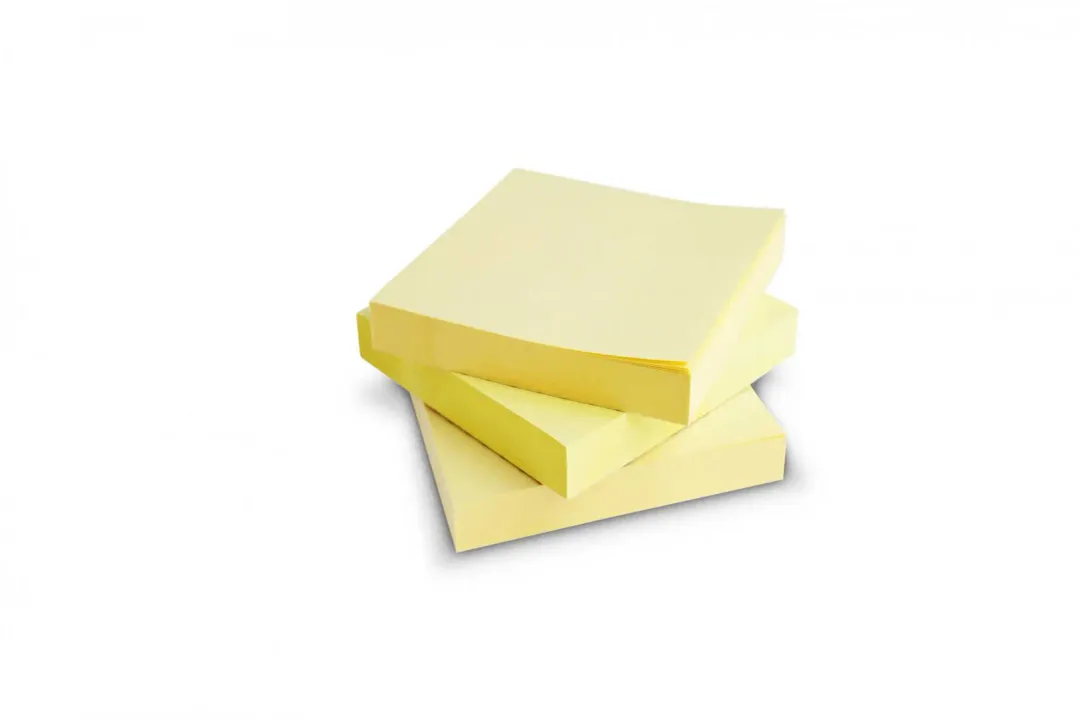
The little squares of colored paper, adorned with a strip of seemingly magical, non-permanent adhesive, are fixtures in offices, kitchens, and classrooms worldwide. They are the universal language of temporary notes, reminders, and brainstorms. Yet, the story of the Post-it Note—that ubiquitous tool now synonymous with organization—is not one of deliberate design but rather a sequence of fortunate accidents, a classic example of failure breeding innovation at the massive company 3M. [1][4]
# Accidental Adhesive

The genesis of what became the Post-it Note starts not with a need for a better bookmark, but with a quest for a stronger one. In 1968, Dr. Spencer Silver, a scientist working at 3M, was trying to engineer a super-strong adhesive for use in the aerospace industry. [6][7] His goal was to create a glue that could hold things together firmly, perhaps for use in building aircraft or other demanding applications. [1]
What Silver ended up creating was, by his own standards, a spectacular failure. [4][5] Instead of achieving a tenacious bond, he developed a unique, pressure-sensitive microsphere adhesive. [1] This formulation created a bond that was surprisingly weak—it stuck lightly to surfaces but could be peeled off easily without leaving residue or damaging the underlying material. [5][7]
Silver recognized that he had created something novel, but for years, the adhesive languished in the laboratory. [4][6] It was seen within 3M as a solution without a problem; a glue that didn't stick well enough was deemed commercially useless in an environment focused on high-performance materials. [4][5] The lack of an immediate, obvious application meant that the product was essentially shelved, awaiting a purpose that no one could readily define. [4] Silver spent years trying to pitch his "low-tack" adhesive to colleagues across the corporation, often meeting resistance because people simply didn't know what they would do with glue that wasn't permanent. [1][7]
# The Missing Link
The breakthrough that transformed Silver’s "failed" glue from a laboratory curiosity into a world-changing product came from an entirely different department and an entirely different kind of problem. [7] Enter Art Fry, another 3M scientist, who was active in his church choir. [4][7]
Fry faced a common, albeit annoying, frustration: the small paper bookmarks he used to mark hymns in his choir hymnal kept falling out every time he opened the book or moved around. [4][7] He needed a bookmark that would stay put but wouldn't permanently damage the thin pages when removed. [4] The realization dawned on him that Spencer Silver's weak, repositionable adhesive was the perfect answer to his specific, personal need. [4][7]
This collaboration—the chemist with the misapplied science and the engineer with the specific application need—is the crucial second accident in the story. [7] Had Fry not been looking for a temporary marker, or had Silver never bothered to keep samples of his adhesive on file, the Post-it Note might never have materialized beyond the lab bench. [1] This convergence of an accidental material and an accidental, yet relatable, human frustration is what moved the concept forward when pure commercial logic had stalled it. [4]

# Market Hesitation
Even after Fry successfully applied Silver's adhesive to slips of paper, the path to mass market success was far from assured. [4] It took a considerable amount of internal championing—estimated by some accounts to be nearly five years—to convince 3M management that this product was worth taking to the wider public. [4][7] Selling an adhesive that intentionally did not stick permanently required convincing both the company and the consumer that there was value in impermanence. [4]
When the product finally launched in a test market in Boise, Idaho, the results were initially underwhelming. [4] Customers didn't immediately grasp the utility of the expensive paper squares. The initial adoption curve was slow, which is a situation that often spells doom for new products. In fact, the success of the Post-it Note required a significant internal push; 3M representatives actually went out to offices and showed people how to use the notes, a level of direct hand-holding rare for a product that is now self-explanatory. [4]
It strikes one as fascinating that a product now globally recognized needed a full-blown evangelical effort just to prove its concept. Consider this practical angle: in a typical office setting where a stack of 100 Post-it Notes costs perhaps a dollar, the perceived value must be exponentially higher to justify the initial investment in convincing a user to pick up a seemingly overpriced piece of colored paper. [1] The initial cost of convincing the consumer to experiment overshadowed the potential utility they hadn't yet experienced.
# Beyond the Initial Stick
The true brilliance of the Post-it Note lies in the way it functions as a low-friction innovation tool, a point that goes deeper than just remembering to buy milk. The very nature of the adhesive dictates how people use it, forcing a certain type of interaction that permanent tools prohibit. [1]
For instance, when you use a regular piece of paper or tape, you are committing. You are making a decision about permanence. With a Post-it Note, the decision is inherently temporary, encouraging rapid iteration and communication. [7] This contrasts sharply with older methods, such as scribbling a note on a desk calendar or using permanent tape to affix a reminder to a monitor.
If you map the innovation process onto the note-taking process, the Post-it Note facilitates a kind of low-stakes brainstorming. [1] A team can generate twenty ideas on twenty separate notes and physically rearrange them on a wall to test flow and structure before committing those ideas to a formal document. This physical manipulation and easy rearrangement—made possible by Silver’s "failed" glue—is an emergent property of the product that no one anticipated when it was invented. [7] This ability to build and deconstruct visual hierarchies on the fly is perhaps the most significant, albeit accidental, contribution to modern project management methodologies.
# The Inventors Recognized
While the invention story centers on two men, the overall success story of 3M itself is rooted in a culture that, despite occasional internal friction, supported the pursuit of curiosity-driven science. [2] Spencer Silver’s initial work was indeed funded by the company, even if the application wasn't immediately clear. [6]
Silver eventually received numerous accolades for his invention, including the 3M Carlton Award, the company’s highest award for research and development, demonstrating that the organization eventually recognized the immense value hidden within the initial mistake. [1] Art Fry, the man who found the use case, is often credited alongside Silver as the co-inventor, ensuring that both the material science and the application concept are acknowledged. [7] The initial adhesive itself was developed over four years, from 1968 to 1972, illustrating that even the accident required time and iteration to stabilize. [6]
The slow market introduction followed by explosive success is a narrative seen in many iconic products, but the Post-it Note remains unique because its success hinged on solving a problem that the inventor hadn't even known existed when he formulated the substance. It wasn't a case of perfecting a known technology; it was a complete paradigm shift in recognizing the utility of non-stickiness. [4] The initial low sales figures, later corrected through aggressive internal marketing and sampling, taught 3M an important lesson about delayed gratification in truly disruptive innovations. [4] They learned that sometimes, the market needs to be educated about an entirely new way of thinking, not just sold a better version of an old way.
#Videos
How Post-it Notes Are Made – The $4 Billion Accidental Invention
Related Questions
#Citations
How Post-it Notes Were Invented by Mistake - Ideawake
History of Post-it® Notes | Post-it® Brand
The Post-it: an idea that stuck thanks to an accidental invention
The TRUE story of Post-It Notes, and how they almost failed
TIL that the Post-It note was invented by a scientist at 3M ... - Reddit
1968: The Accidental Birth of Sticky Notes
The History of Post-it Notes: The Accidents That Led to the Invention ...
How Post-it Notes Are Made – The $4 Billion Accidental Invention
History of post-it notes creation - Facebook